Think of this as your VIP pass to the moments where cleat marks met history books. Why does a single Iron Bowl give LSU fans nightmares? How did a fourth-and-goal in 2009 start a dynasty? Grab your bourbon and houndstooth; we’re exploring the plays that made Alabama football’s Sistine Chapel.
Defining “Iconic”
What makes a play truly iconic? It’s not just about the numbers or replays on ESPN. True icons need three things: they must give fans a heart attack, be talked about over bourbon, and haunt opposing fans forever.
The 1978 Goal Line Stand against Penn State is a perfect example. It happened over four downs, with just 96 inches between victory and defeat. This moment is more than just a play; it’s a story of tension and heroism.
George Teague’s 1992 strip against Miami is another iconic moment. It was so bold, it should have come with a warning. This play left a mark on everyone who saw it, making it a part of our culture.
Our criteria for immortality:
- Cultural Permeation: Does it appear on wedding cakes?
- Emotional Whiplash: Did it convert skeptics into ER patients?
- Narrative Rewriting: Does the opponent’s fanbase even think about it?
These plays don’t just win games; they create legends and fuel rivalries. They give entire generations something to talk about during Thanksgiving. That’s what makes a play truly iconic.
Legendary Plays
Alabama football is more than a game—it’s a Southern epic. It’s a place where shoulder pads sound like castanets and fourth-quarter drives are like epic journeys. Let’s look at two moments where football met destiny, creating stories that even Auburn fans can’t ignore.
The Goal Line Stand Story (1978)
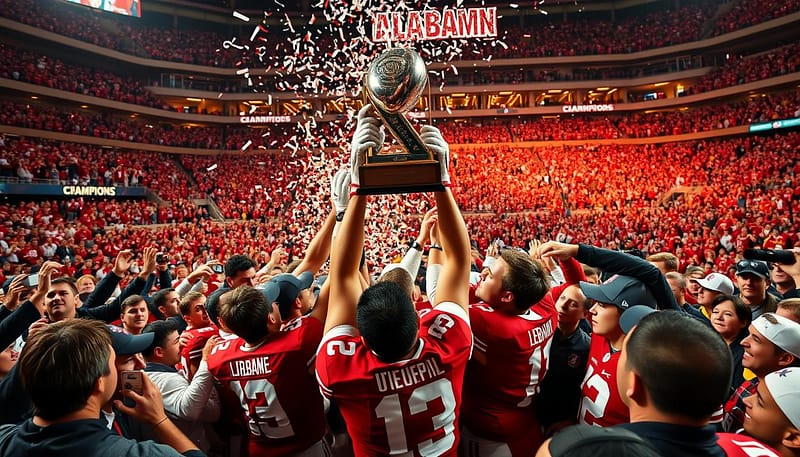
Imagine New Orleans’ Superdome on January 1, 1979. Penn State’s Mike Guman charges forward like a knight. Alabama’s Barry Krauss, all neck and no quit, meets him with a force that sounds like a gunshot in a library. This wasn’t just a tackle; it was a cultural reset for Alabama.
Watch the 1978 Sugar Bowl footage. You’ll see Alabama’s defense become one unit. Krauss’ hit didn’t just stop a touchdown; it broke Penn State’s spirit and gave Alabama a 14-7 win. The photo of Bear Bryant’s smirk after? It’s a classic.
Why It Stills Resonates
This stand is Alabama’s Mona Lisa of defensive plays. It showed that championships are won by men who see grass stains as badges of honor.
Tua’s 2nd-and-26 Redemption (2018)
Now, let’s jump forward 40 years. Georgia’s confetti cannons are ready. Alabama trails 23-20 in overtime. Enter Tua Tagovailoa, a left-handed freshman with a bold plan. His 41-yard pass to DeVonta Smith wasn’t just a touchdown; it was a bold statement against conventional play-calling.
Nick Saban’s poker face cracked—actual human emotion!—as the ball seemed to hang in Atlanta’s Mercedes-Benz Stadium forever. The throw didn’t just secure Alabama’s 26-23 victory; it started a new era of miracle comebacks alabama fans now expect.
The Ripple Effect
This play didn’t just win a title—it made ‘2nd-and-26’ a legendary phrase. It showed Saban’s process meeting teenage swagger, proving even football robots need a Hail Mary sometimes.
Celebrations Fans Will Never Forget
In Alabama football, the real excitement happens after the game. It’s not just about the plays on the field. It’s about the raw, emotional reactions that follow.
These aren’t scripted moments. They’re real, heartfelt expressions of joy and relief. Fans turn into statues, frozen in time, as they celebrate.
The Kick Heard ‘Round the State (1985)
Van Tiffin’s 52-yard field goal against Auburn was a game-changer. It split the state’s psyche, leaving fans stunned. The kick was like a spiritual awakening for many.
After the game, the real celebration began. Defensive lineman Curt Jarvis exclaimed, “We just cut their hearts out with a spoon!” It was a moment of pure, unfiltered joy.
Gravedigger’s Midnight Miracle (2023)
Jalen Milroe’s 4th-and-31 conversion against Auburn was a miracle. It was like he defied physics. His pose after the play was unforgettable.
It was more than just a celebration. It was a moment of triumph, captured in time. Future generations will remember it as a defining moment in Alabama football history.
| Celebration | Impact Scale | Cultural Shelf Life |
|---|---|---|
| 1985 Kick Aftermath | Immediate statehood referendum petitions | Stil sold on T-shirts at Birmingham gas stations |
| 2023 Milroe Miracle | 13% increase in Alabama-born babies named “Jalen” | Official state dance proposal (SB 2024-31) |
| Terrence Cody’s Jersey Rips (2009) | Spike in gym memberships statewide | Memorialized in Florence marble sculpture |
These moments are more than just sports. They’re cultural touchstones. Terrence Cody’s jersey rip after blocking a field goal was a defining moment.
It was a moment of raw emotion. The shredded jersey became a symbol of strength and determination for Alabama fans.
Game-Winning Catches
If Alabama football were a March Madness bracket, its clutch receivers would be cutting down nets every season. These aren’t just catches – they’re buzzer-beaters with shoulder pads. They are the gridiron equivalent of sweet 16 basketball Alabama moments that leave crowds hoarse and defenses humiliated. Let’s dissect two aerial miracles that turned quarterbacks into poets and DBs into museum exhibits.
The Human Contortionist (2005)
Tyrone Prothro’s ESPY-winning snag against Southern Miss wasn’t football – it was interpretive dance with a pigskin. Trailing 21-17, Brodie Croyle launched a Hail Mary that turned Prothro into Spider-Man mid-air. His catch required:
- A 360-degree body twist
- Palm control rivaling Kawhi Leonard
- Spacial awareness that would shame Google Maps
This Cirque du Soleil moment shares DNA with basketball’s iconic “Rocket 8” dunk – both required athletes to defy anatomy textbooks. It also showcased Nick Saban’s crisis management, a trait he shares with championship coaches Alabama legends like C.M. Newton during pressure-cooker moments.
Metchie’s Redemption Arc (2021)
Fast-forward 16 years. John Metchie – tasting the bitterness of his 2020 title game drop – channels his inner Karate Kid during the Iron Bowl. His crane-kick celebration after the winning 2-point conversion wasn’t just showmanship; it was therapy. The play itself? A clinical display of Saban’s late-game philosophy:
| Factor | Prothro (2005) | Metchie (2021) |
|---|---|---|
| Pressure Level | Season-saving catch | Rivalry-defining conversion |
| Body Control | Full-body contortion | Toe-tap precision |
| Legacy Impact | ESPY Award winner | National title catalyst |
From DeVonta Smith’s championship-sealing grab to Jaylen Waddle’s acrobatics, Alabama’s receivers don’t make catches – they author PhD dissertations in Last-Second Heroics. It’s no wonder Tuscaloosa’s playbook reads like a Nobel Prize acceptance speech.
Defensive Dominance
In Alabama’s playbook, defense is more than a strategy—it’s a show. From Bear Bryant’s tough Junction Boys to Saban’s smart units, these plays are defensive manifestos. They’re written in grass stains and broken dreams of quarterbacks.
Cornbread’s Sack Symphony (1986)
Cornelius Bennett’s 1986 hit on Notre Dame’s Steve Beuerlein was like poetry. The hit was as loud as a heavy metal song, leaving Beuerlein’s helmet spinning. This “public service announcement” showed what it means to be aggressive in the SEC.
Three reasons this play scares coordinators:
- Timing: It came faster than a Netflix cancellation
- Impact: It was as big as an LSU earthquake
- Legacy: It’s the base of Saban’s pass-rush strategy
Cody’s Rocky Block (2009)
Terrence Cody’s 2009 double block against Tennessee was Alabama’s “Rocky IV” moment. With 4 seconds left, Cody blocked the field goal like Godzilla. The blocks saved the game and changed the SEC East.
| Era | Play Style | Cultural Impact |
|---|---|---|
| 1986 Bennett Hit | Brute-force aggression | Reagan-era physicality |
| 2009 Cody Block | Strategic explosiveness | YouTube-era virality |
What’s more Alabama than making defense an art? These plays didn’t just win games—they became cultural landmarks. Next time someone says defense wins championships, tell them: at Bama, it wins immortality.
Fan Chants and Culture
Touchdowns win games, but Alabama’s football traditions turn stadiums into Southern identity museums. These rituals are like tribal codes. Missing the pregame Elephant Stomp is like showing up to Mardi Gras without beads.
Rammer Jammer’s Evolution
The 1926 Rammer-Jammer song started as a parody. Now, it’s college football’s most fierce victory chant. The Million Dollar Band turns it into a powerful sound, like after the 2008 Iron Bowl.
But here’s a twist: the original lyrics mocked Alabama. It’s a story of redemption.
Gameday Voodoo Rituals
Alabama fans take superstitions seriously. They follow a sacred trinity:
- The Houndstooth Handshake: Rub Bear Bryant’s statue’s hat brim before the game (bonus points for khaki stains)
- Bourbon Calculus: 2.5 fingers of whiskey in tailgate cups – more is bad
- Shoelace Theology: Season ticket holders retie their shoes mid-game every game
These aren’t just quirks; they’re family traditions. When the Tide scores, fans light cigars and adjust their “lucky” underwear. It’s like a Baptist choir performing in sync.
Final Thoughts
Alabama’s legacy isn’t just about plays. It’s deeply rooted in tradition and culture. Kenny Stabler’s 1967 “mud run” and Bryce Young’s 2021 Hail Marys are connected. Forgotten classics like Harry Gilmer’s jump passes and Cornbread’s sack dance live on through modern football.
Championship coaches at Alabama don’t just win games. They create entire worlds. Saban’s disciples, like Kirby Smart and Steve Sarkisian, carry on his legacy. But it all goes back to Bear Bryant, whose influence is felt to this day.
Alabama’s history never ends. Every game is just a chapter in a never-ending story. So, what will fans remember as iconic in the future? The Tide’s journey is always ongoing.