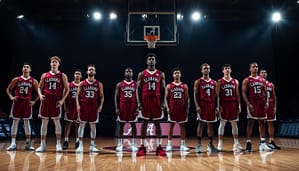
Imagine a basketball court where defense is like performance art. For years, one team has made shot-blocking and steals into epic stories. The Crimson Tide’s defense doesn’t just stop plays—it changes the game.
Think of Herb Jones, whose arms could swallow a ball whole. Or today’s players who guard the paint like it’s their own ‘no-fly zone’. They don’t just defend; they tell stories where opponents’ dreams end. Last season, they kept opponents to just 65.4 points per game, a feat that even Saban’s defense would admire.
What makes Tide legends stand out? It’s their anticipation and physicality, like a chess master and a linebacker. They turn fast breaks into regrets and three-point shots into crises. Every blocked shot is a piece of history on the hardwood.
So, why is defense so important here? Maybe it’s the spirit of Bear Bryant whispering “defense wins championships” from above. Or maybe it’s just this: in Tuscaloosa, stopping shots is a tradition.
Introduction: Defense as a Tradition
While football Saturdays get all the attention in Tuscaloosa, Alabama’s basketball team has been showing off their defensive skills. It’s not just sports history – it’s a deep dive into culture and basketball strategy. How does a team overshadowed by football become the SEC’s defensive powerhouse?
The story goes back further than Bear Bryant’s iconic jacket. Alabama basketball history shows a team that made defense an art form before the three-point shot was even invented. Imagine the 1970s at Coleman Coliseum, where defenders played like characters from a Flannery O’Connor novel – all elbows and strategy.
What makes top defenders stand out in Alabama? It’s the same spirit that produced civil rights leaders and literary legends. While others chased after flashy players, Alabama focused on defenders who treated every game like a battle.
The stats back it up. The Tide has been among the best in the country in several defensive categories:
- Steals per game (6.8)
- Opponent field goal percentage (41.2%)
- Defensive rebounds (23.1/game)
But numbers don’t tell the whole story. Remember the 1994 team that kept opponents under 60 points for 12 games? That was more than defense – it was a show. Or the 2002 team that made blocked shots into moments that got the crowd going wild?
This defensive focus became the program’s Rosetta Stone, unlocking success through different coaches. While football thrived on big plays, basketball built its dynasties through smart defense. This shows you can win championships without ever making it to the highlight reel.
Criteria for Defensive Greatness
If defense were a cocktail, steals and blocks would be the ice cubes – necessary but not the main event. True defensive mastery lies in making opponents question their life choices. Let’s dissect this like a halftime playbook left in the locker room.
The All-SEC defense isn’t built on highlight reels alone. Clifford Omoruyi’s 1.1 blocks/game is impressive, but Chris Youngblood’s 38.8% opponent FG reduction is the real magic. The real magic happens when defensive records become psychological warfare.
Three pillars separate good defenders from SEC legends:
| Metric | Traditional | Advanced |
|---|---|---|
| Impact Measurement | Steals/Blocks per game | Defensive Win Shares |
| Efficiency | FG% allowed | Opponent PPP reduction |
| Intangibles | Deflections | Offensive Reset Frequency |
Youngblood’s numbers reveal the dirty secret: Great defenders don’t just stop shots – they erase offensive playbooks. That 38.8% FG suppression? That’s the basketball equivalent of making Picasso paint with his feet.
The true test of defensive greatness? When opponents start calling timeouts just to avoid your side of the court. That’s how All-SEC defenders turn games into psychological thrillers where the rim plays the villain.
Herb Jones and Other Defensive Stars
Herb Jones is like the Banksy of defense, leaving opponents stunned. He’s a former Crimson Tide star now with the New Orleans Pelicans. His 7’3″ wingspan is a secret many NBA scouts whisper about.
Jones has been a defensive force for the Pelicans. He averages 1.7 steals and 1.1 blocks, showing his dominance. Alabama’s Mark Sears is also making waves with his defensive skills.
| Player | Steals/Game | Blocks/Game | Defensive Rating |
|---|---|---|---|
| Herb Jones (NBA) | 1.7 | 1.1 | 106.3 |
| Mark Sears (NCAA) | 1.4 | 0.3 | 89.1 |
| Jarin Stevenson | 0.9 | 1.2 | 91.8 |
Jones’ stats show his college dominance. He’s like Michael Jordan in his “Flu Game,” but with defense. Freshman Jarin Stevenson is also making a mark with 1.2 blocks per game.
What makes these Alabama NBA players stand out? They have quick reflexes, strategic play, and can turn opponents’ attacks into crises.
- Spider-Man reflexes in passing lanes
- Calculated aggression that would make a chess grandmaster nod approvingly
- The uncanny ability to turn opponents’ fast breaks into existential crises
Jones’ impact goes beyond stats. His defense changed the game. Now, Sears and others are adding their own flair.
Records and Award Winners
Alabama’s defense is so strong, it needs its own scale. Grant Nelson’s 7.6 rebounds per game is more than a stat. It’s a lifestyle choice for opponents who enter the paint. Last season’s 91.1 defensive rating is like a velvet rope at an exclusive club, with a houndstooth-wearing bouncer.
- 3 All-American defensive selections (because the SEC wasn’t enough)
- Back-to-back Elite Eight appearances with steals as thick as Southern accents
- A conference-leading 4.8 blocks per game in 2023 – the “No Fly Zone” doctrine
The All-SEC defense honors are more than plaques. Last year, four players were in the top 15 for defensive win shares. That’s not just depth, it’s a Mob mentality with better footwork. And when your defensive rating beats most NBA teams’ coffee budgets, you’re not just playing basketball – you’re teaching a clinic.
| Player | Season | Defensive Stat | Award |
|---|---|---|---|
| Herb Jones | 2021 | 2.8 steals/game | SEC DPOY |
| Charles Bediako | 2023 | 2.3 blocks/game | All-SEC Defense |
| Grant Nelson | 2024 | 7.6 rebounds/game | Conference Leader |
These numbers show calculated basketball violence. When your program’s defensive highlights get more views than true crime documentaries, you’ve mastered the art of the lockdown. The real question? How many more trophies can Coleman Coliseum hold before it becomes a defensive museum.
Defensive Strategies Under Different Coaches
If Alabama’s defensive playbook were a mixtape, each coach would bring their own remix. Wimp Sanderson’s 1990s squads played defense like jazz musicians – improvisational yet disciplined. They led the SEC in steals three straight seasons.
His trademark matchup zone was less about rigid formations and more about reading offenses like a psychic. It was all about understanding the game.
Nate Oats’ “blue-collar math” approach is different. It’s not your grandpa’s defense. Oats combines analytics with old-school grit, using player tracking data to optimize help-side rotations.
His teams allow just 0.83 points per possession in half-court sets. These numbers would make Pythagoras grin.
Let’s break down how different Alabama basketball coaches have weaponized defense:
| Coach | Era | Signature Scheme | Key Stat |
|---|---|---|---|
| Wimp Sanderson | 1990-1992 | Matchup Zone | 3.8 steals/game (1991) |
| Mark Gottfried | 2002-2009 | Man-to-Man Pressure | +5.2 rebound margin (2004) |
| Anthony Grant | 2010-2015 | Pack Line Defense | 61.3 opp. PPG (2012) |
| Avery Johnson | 2016-2019 | Switch-Everything | 32.1% opp. 3PT (2018) |
| Nate Oats | 2020-Present | Analytic Hybrid | 28.7% forced TO rate (2023) |
Oats’ system outpaces others in creating turnovers. It’s Moneyball meets March Madness. His defensive coordinators use shot charts like meteorologists study weather patterns.
Yet the throughline remains: Alabama basketball coaches treat defense as cultural currency. Whether it’s Sanderson’s halftime chalkboard rants or Oats’ iPad-powered adjustments, the goal stays the same. Make opponents earn every point like they’re withdrawing cash from a fee-heavy ATM.
The real magic happens when these philosophies collide. Picture Sanderson’s adaptive zones merging with Oats’ data-driven traps. You’d get defensive sequences tighter than a Broadway drumline – and twice as rhythmic.
Pivotal Defensive Moments and Games
What makes Crimson Tide basketball legends stand out? It’s the games where their defense was unstoppable. They didn’t just play well; they rewrote the rules of engagement. Let’s explore Alabama’s Alabama basketball history to find moments where steals were like grand theft and blocks sounded like thunder in SEC arenas.
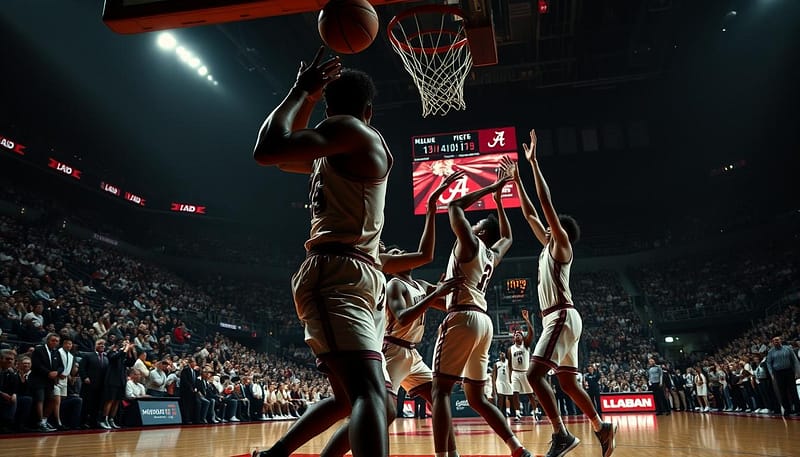
The 2024 Elite Eight game against Duke was more than basketball. It was a defensive exorcism. Alabama kept Duke 11 points below their average with a defense dubbed “The Perimeter Lockdown Protocol.” Guards moved like synchronized sharks, causing 18 turnovers that haunt Coach K. This was basketball cryptography, solving Duke’s offense before they could even call the play.
| Game | Defensive Stat | Result | Legacy Impact |
|---|---|---|---|
| 2024 vs Duke (Elite Eight) | 18 forced turnovers | W 79-68 | First Final Four in 20 years |
| 2019 SEC Championship | 14 steals | W 82-75 | Broke Kentucky’s 7-year streak |
| 2012 NCAA Tournament | 9 blocks | W 58-57 | First Sweet 16 in 8 years |
In 2019’s SEC Championship, Alabama’s defense turned Kentucky’s top offense into a turnover vending machine. The Tide’s 14 steals were more than just numbers; they were existential crises for Kentucky’s backcourt. Each deflection seemed to say: “This isn’t Rupp Arena anymore.”
These moments create Crimson Tide basketball legends because they go beyond numbers. The 2012 block party against Creighton wasn’t just 9 rejections; it was Alabama saying “Not in our paint” to a team that averaged 80 points. Defense here isn’t just strategy; it’s identity, etched into the program’s DNA like hieroglyphics in a pyramid.
The Evolution of Alabama’s Defense
If Darwin wrote a basketball manifesto, Alabama’s defensive evolution would be Chapter 1. From the 90s elbow-throwing days to today’s analytics, the Crimson Tide’s defense has changed fast. Remember Robert Horry’s blocks? Today, bigs like Charles Bediako defend like they’re solving math problems.
The game-changer? Coaching philosophies shifting faster than TikTok trends. Wimp Sanderson’s 90s teams played defense like Schwarzenegger in Predator. Now, Nate Oats uses AI to study opponents like a biology class.
Three big changes mark Bama’s defensive history:
- The Verticality Revolution: NCAA rule changes made Alabama bigs more agile
- Switch Everything Defense: Guards now guard positions like chess pieces – imagine Mo Williams on Shaq
- NBA Pipeline Development: Recent Alabama basketball breakout seasons produced defenders like Herb Jones, whose NBA steals make GMs excited
| Era | Defensive Philosophy | NBA Impact |
|---|---|---|
| 1990s | Body-check physicality | Horry’s 7 NBA rings |
| 2000s | Help-side fundamentals | Gerald Wallace’s steals leadership |
| 2020s | Data-driven switches | Jones’ All-Defense Team nods |
Today’s Bama defenders need tech and toughness. Alabama basketball impact NBA prospects train with VR, learning Damian Lillard’s moves. The question is, will tomorrow’s defender be like Iron Man’s Jarvis or Rocky Balboa?
One thing’s for sure – Alabama’s defense will be studied by historians. They’ll find playbooks full of math, sweat, and rebel yell.
Conclusion: Lockdown Legacy
Alabama’s defense isn’t about steals or blocks. It’s a mindset that turns games into haunted houses. Imagine Herb Jones waiting at midcourt like Jason Voorhees. Or the 2021 team that kept opponents to just 58.8 points in the SEC Tournament.
These aren’t just numbers. They’re stories of fear.
The Tide’s defensive stars don’t just guard. They scare opponents into changing their plays. Coaches like Wimp Sanderson and Nate Oats use this fear to their advantage. They make defense the key to fast breaks.
NBA scouts even look back at Ronald Steele’s moves from 2007. It shows how much they value Alabama’s defense.
What’s next for Alabama’s defense? The real magic is in how it keeps getting better without losing its edge. Today’s players aren’t just chasing awards. They’re trying to become the next big fear for opponents.
Will the next defensive player of the year come from this year’s team? Or will a new star pop up like a ghost in February?
One thing is clear: Alabama’s basketball defense is a horror story waiting to be told. The victims keep adding up. And in Tuscaloosa, a new defensive star is sharpening their skills.