Alabama football tradition is not built only by trophies in glass cases. It is built when old championship teams return to Bryant-Denny Stadium and remind the current one that history is not decoration in Tuscaloosa — it is pressure.
Even outside Tuscaloosa, the broader betting sports landscape treats football weekends as cultural events, not just scheduled games. That is why Alabama’s use of reunions has power. It gives the home schedule a story arc before the season writes its own.
Alabama has placed those recognitions inside a home schedule that already carries weight. The 1966 SEC Championship Reunion is set for the Florida State game on September 19, while the 2016 SEC Championship Reunion is scheduled for the Texas A&M game on October 24, which also serves as Homecoming. The same home slate later brings Chattanooga on November 21 and Auburn on November 28, giving the season a clear rhythm of memory, expectation, and rivalry.
Alabama football tradition is never only about nostalgia
That is what makes Alabama’s 2026 plan to honor the 1966 and 2016 SEC Championship teams feel bigger than a pair of reunion weekends. The two ceremonies sit between Bear Bryant’s undefeated era and Nick Saban’s modern machine, making them a natural extension of the coaches who shaped Alabama football and the standard every new Alabama team inherits.
A reunion can look simple from the outside. Former players return. The stadium applauds. A highlight video plays. Names are announced. The crowd gets one more reason to stand.
At Alabama, that moment carries a sharper edge.
The program does not use history as a museum tour. It uses history as a living scoreboard. Every generation is measured against the last one, and the best Alabama teams are not remembered only because they won. They are remembered because they defined what winning was supposed to look like.
That is why honoring 1966 and 2016 in the same season is so pointed. One team represents an unresolved argument from the Bear Bryant era. The other represents the clean, ruthless efficiency of the Nick Saban era. Together, they create a timeline that does not flatter the present team. It challenges it.
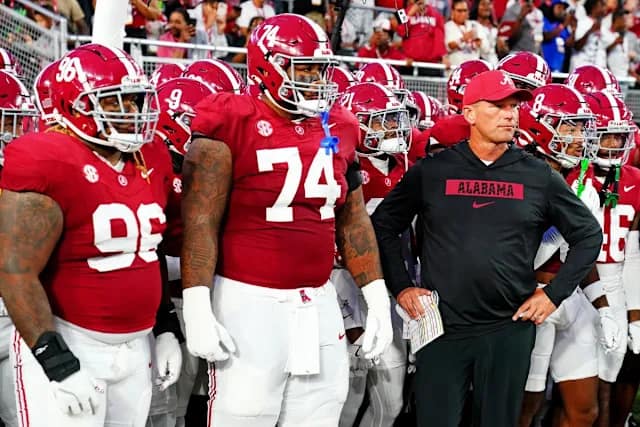
For Kalen DeBoer’s Alabama, that matters. The post-Saban period is not judged like a normal coaching transition. Most programs ask whether a new coach can win enough. Alabama asks whether he can protect a language, a posture, and a set of expectations that existed long before he arrived.
Two championship reunions, two very different messages
The 1966 and 2016 teams both won the SEC, but they do not symbolize the same thing. That contrast is exactly why these recognitions fit the 2026 season so well.
| Team Being Honored | Reunion Game | Core Meaning | Message For 2026 Alabama |
|---|---|---|---|
| 1966 SEC Championship team | Florida State, Sept. 19 | Undefeated season, Bear Bryant legacy, national-title debate | Great seasons can still leave unfinished business |
| 2016 SEC Championship team | Texas A&M, Oct. 24 | Saban dominance, SEC control, playoff-era power | Alabama’s best years set a nearly impossible standard |
| 2026 Alabama team | Full home season | DeBoer era identity test | The current program must turn history into performance |
The table shows why this is more than ceremony planning. The 1966 team and the 2016 team represent two separate burdens. One reminds Alabama that even perfection can become complicated. The other reminds Alabama that dominance can look almost routine when the machine is fully built.
That is the hard part about being Alabama. The past is not distant enough to be harmless.
The 1966 team still carries the weight of unfinished history
The 1966 Alabama team is one of the most fascinating groups in the program’s history because its story is not clean. It finished unbeaten at 11-0, captured a share of the SEC championship, and beat Nebraska 34-7 in the Sugar Bowl after the season.
Yet the team remains linked to one of college football’s loudest historical arguments: Alabama was not crowned national champion by the major polls. Notre Dame and Michigan State finished ahead of the Tide after their famous 10-10 tie, leaving Bryant’s undefeated team in a position that still bothers Alabama fans six decades later.
That is why the 60-year reunion against Florida State is not just a polite nod to old greatness. It brings back a team that still feels like an unfinished argument. Alabama fans do not remember 1966 only as a championship year. They remember it as proof that winning everything on the field does not always settle everything outside it.
That history fits awkwardly well in the modern sport. Rankings, playoff selection debates, conference strength, television windows, and national perception still shape how teams are judged. Alabama has benefited from that world and suffered inside it. The 1966 team is a reminder that the Tide’s obsession with control comes from experience.
The lesson is not simply that Alabama went undefeated. The lesson is that Alabama learned long ago that excellence must be loud enough to survive the politics around it.
The 2016 reunion reminds Alabama what domination looked like
The 2016 team sends a different message. That group belongs to the Saban era’s fully formed empire: fast, physical, deep, disciplined, and comfortable carrying national expectations every Saturday.
Alabama beat Florida 54-16 in the SEC Championship Game that season and reached the College Football Playoff. Jalen Hurts was a freshman quarterback leading a title-caliber roster. Reuben Foster was the defensive tone-setter. The roster felt less like a team hoping to reach the sport’s highest level and more like one that had been engineered to live there.
That is why the 10-year reunion during Texas A&M weekend matters. The 2016 team is not ancient history. Many current recruits grew up with Alabama’s Saban-era dominance as the sport’s background noise. Their idea of Alabama was formed by playoff games, first-round picks, defensive violence, and an annual expectation that the Tide would be near the top of the rankings.
That creates a standard of comparison that can be unfair but unavoidable. Alabama is not trying to convince people it used to be great. It is trying to prove that greatness was not tied to one coach, one roster, or one decade.
The 2016 reunion will bring back a version of Alabama that still feels recent enough to sting. Fans can remember the names. Recruits can recognize the NFL paths. Current players can feel the shadow.
The 2026 schedule turns memory into pressure
The timing of these ceremonies gives the season extra texture. Alabama’s official home recognition schedule places the 1966 reunion against Florida State and the 2016 reunion against Texas A&M, two games that already carry national attention for different reasons.
Florida State brings brand value, postseason history, and a fan base that understands its own complicated relationship with college football selection debates. That makes the 1966 reunion feel especially sharp. It is a game wrapped in legacy before the ball is even kicked.
Texas A&M brings SEC pressure and Homecoming energy. Placing the 2016 reunion there turns a conference game into something more emotional. The stadium will not simply be celebrating a past team. It will be comparing the current team’s edge, depth, and discipline against one of the most imposing Alabama groups of the playoff era.
Then comes Chattanooga on November 21, with Senior Day and Bama Salute, before Auburn arrives on November 28. That closing stretch matters because the Iron Bowl needs no additional ceremony. The rivalry supplies its own history.
Recruiting is part of the ceremony
The emotional value of these reunions is obvious. The recruiting value is more subtle, but just as important.
When Alabama brings back championship teams, it is not merely entertaining fans. It is staging proof. A recruit sitting inside Bryant-Denny Stadium can see the program’s pitch without needing a coach to explain it. Former players walk onto the field. The crowd reacts. The video boards show moments that still matter. The entire building becomes recruiting theater.
That matters in the NIL and transfer-portal era because every elite program can offer facilities, exposure, and opportunity. Alabama’s advantage has to be deeper than amenities. It has to be continuity.
The 1966 team tells recruits that Alabama history goes back further than the playoff era. The 2016 team tells them that the modern version of the program can turn elite talent into championships, awards, and NFL futures. Together, they offer a message most schools cannot duplicate: Alabama does not have to invent tradition for a recruiting weekend. It can bring it back onto the field.
Still, that only works if the current product supports the story. A ceremony can inspire a crowd, but it cannot block a pass rusher, finish a drive, or survive the fourth quarter. If Alabama wants history to help recruiting, the team on the field must make the past feel connected to the present.
The signals Alabama cannot let become decoration
The risk in any tradition-heavy program is that the rituals become louder than the results. Alabama has enough history to fill every Saturday with a tribute. The harder job is making sure those tributes still mean something competitive.
For 2026, the key signal is whether the current team plays with the same seriousness the ceremonies are designed to evoke. Against Florida State, the question will be whether Alabama can turn the 1966 reunion into a statement rather than a sentimental afternoon. Against Texas A&M, the question will be whether the 2016 reunion becomes a reminder of what Alabama still is, not only what it used to be.
The Georgia home game on October 10 adds another layer, even without a listed reunion. Tennessee, LSU, Auburn, and Texas A&M all sit on the schedule as measuring-stick games. The season is not short on tests.
That is why the reunions matter more than the applause. They create a frame around the season. They tell fans, players, recruits, and opponents that Alabama is still speaking in championship terms.
The danger is obvious. If the team falls short, the contrast becomes louder. A program built on memory has to be careful, because memory can inspire, but it can also expose.
Alabama’s best use of tradition has always been active, not decorative. The 1966 and 2016 reunions should not feel like a pause from the 2026 season. They should feel like a challenge placed directly inside it.
That is the real meaning of Alabama football tradition in 2026. The past is coming back to Bryant-Denny Stadium, but it is not coming back to be admired from a distance. It is coming back to ask whether the current Tide can still carry the weight.
Alabama Football Tradition FAQ’s
Why is Alabama honoring the 1966 SEC Championship team in 2026?
The 2026 season marks 60 years since Alabama’s unbeaten 1966 team. That group remains one of the program’s most debated championship-era teams because it finished perfect but was not crowned national champion by the major polls.
Why does the 2016 Alabama team matter so much?
The 2016 team represents the peak rhythm of the Nick Saban playoff-era machine. It won the SEC, dominated Florida in Atlanta, and showed the roster depth and defensive edge that defined Alabama’s modern dynasty.
How do these reunions help Alabama beyond fan nostalgia?
They reinforce identity for players, fans, and recruits. Alabama can use championship reunions to show continuity across eras, but the message only works if the current team performs at a level worthy of that history.