New Orleans mixes cocktails, but Alabama stirs legends. The Crimson Tide’s basketball history is more than just buzzer-beaters. It’s about the coaches who turned strategy into cultural icons.
Forget Bear Bryant’s shadow for a moment. It’s the plaid jackets and old playbooks that really matter.
From 1912 to now, 21 head coaches have shaped Alabama’s basketball. The NJCAA’s Legacy Awards celebrated their impact. Coaches like Wimp Sanderson and C.M. Newton left their mark.
What makes a coaching legacy? It’s not just about wins. It’s the fingerprints left on a program’s soul. These coaches didn’t just draw plays; they defined identity.
Their stories are etched in history books, passed down through generations. It’s like a no-look pass you never saw coming.
Introduction: The Importance of Coaching
Think of Alabama basketball history like a jazz standard. The coach is both the composer and the improvising soloist. They must create a plan for March’s madness, yet also leave room for surprises.
This balance didn’t come out of nowhere. It started with a high school tournament in Birmingham in 1921. This event made basketball important in the South.
The first championship at what’s now the Regions Center was more than just a win. It was the start of program building as an art form. Coaches became curators of regional identity, blending Xs-and-Os with sociology.
Consider this: Pat Dye’s walrus mustache, Wimp Sanderson’s plaid sport coats, and Bear Bryant’s houndstooth are not just fashion. They’re power suits that remind us basketball is performed in Alabama.
The great coaches know when to follow the script and when to break it. They make their programs time capsules, connecting past and present through basketball.
So, when you see a last-second Alabama buzzer-beater, look beyond the swish. You’re seeing a century-long conversation between strategists and creators. The real question is, “What took y’all so long to notice?”
CM Newton: Breaking Barriers
If Bear Bryant had worn sneakers instead of his houndstooth hat, he might have been CM Newton. This coach didn’t just build defenses. He also broke down segregation. When Newton took over Alabama basketball in 1968, he didn’t start with a game plan. He began by recruiting the program’s first Black players during a time of great change.
Newton’s coaching record shows he was a winner. But his biggest achievement was in 1973. His team, made up of players from different backgrounds, won the NIT championship. This victory was more than just a game. It was a turning point for Alabama, changing its image quickly.
As one sportswriter noted, Newton’s impact was huge. His team’s success broke down barriers faster than a full-court press could.
Three key moments highlight Newton’s impact:
- Recruiting Black athletes when SEC schools were slow to integrate
- Winning with a defense-first strategy (his teams allowed just 63.5 PPG)
- Setting the stage for future stars like Robert Horry and Antonio McDyess
Newton’s coaching style was like that of NJCAA’s Jack Robertson. Both understood that real change comes from giving opportunities, not just talking about them. While others focused on plays, Newton changed the game by making defense a team effort. He believed in treating every player as equal, giving everyone a voice.
By 1980, Newton had done more than just win games. He had rewritten Alabama’s playbook for success. His legacy was not just about basketball. It was about breaking down barriers and creating a more inclusive environment.
Wimp Sanderson: The Golden Era

If college basketball had a Mount Rushmore for swagger, Wimp Sanderson would be a giant. He coached Alabama from 1980 to 1992, leading them to 267 wins. They also won three SEC tournament crowns. His style was so bold, it could make a 1970s game show host jealous.
Sanderson was a master of contrasts:
- He outrecruited rivals in style, looking like he shopped at a discount store.
- His Xs-and-Os skills were as sharp as Nick Saban’s football plans.
- He led Alabama to a historic “Sugar Bowl of Basketball” win over #1 UNC in 1987.
His coaching philosophy was as bold as his outfits: “Outwork them Monday through Thursday, outwit them on Saturday.” His .692 winning percentage is the highest in Tide history.
The 1987 season was a turning point for Sanderson. Alabama faced Dean Smith’s Tar Heels, who had future NBA stars. Sanderson’s defense was so strong, it could’ve withstood hurricane winds. The 85-69 win over UNC was a huge upset and a lesson in proving blueblood programs can bleed crimson too.
Though Coleman Coliseum doesn’t have a banner for “Best-Dressed Coach,” Sanderson’s dry cleaner should be in the Alabama Sports Hall of Fame. He turned sideline fashion into a performance art, like the Pat Riley of plaid.
Mark Gottfried and March Madness
Ever seen a Crimson Tide player dunk on Shaq? Exactly. Before Nate Oats’ teams, Mark Gottfried’s teams in the early 2000s changed Alabama basketball. They were like Moneyball meets March Madness—efficient, flashy, and exciting.
Gottfried’s 2004 Elite Eight team didn’t rely on top recruits or viral dunks. It was a blueprint for Alabama basketball breakout seasons. Gerald Wallace and Kennedy Winston were key players. They made Coleman Coliseum a place of wonder.
Gottfried focused on positionless basketball before it was trendy. His teams had players who could do it all. This led to a 27-win season in 2002 and two SEC titles.
But here’s the best part: Gottfried’s teams made Alabama matter in March. Before him, the Tide had only one Sweet 16 appearance in 20 years. Under Gottfried, they made three NCAA bids in five years, including a close 2004 run against UConn.
So, when someone says Alabama basketball started with Oats or Saban’s speeches, remind them of Gottfried. His teams were the first to prove the Tide could go past the second weekend. They did it with less fanfare and more grit than you’d expect.
Avery Johnson and Modern Change
Avery Johnson walked into Tuscaloosa with confidence and swagger. He was a former NBA Coach of the Year. He aimed to make Alabama a factory for Alabama NBA players. But his time (2015-2019) was like a Tesla stock chart – exciting highs and debates about value.
- NBA Pedigree: Coached Dirk Nowitzki to finals glory • Developed 15+ NBA players • Salary cap expert
- College Reality: 75-62 overall record • One NCAA tournament appearance • Zero SEC titles
Johnson’s biggest achievement was Collin Sexton. Sexton was like Bitcoin in college basketball – unpredictable but unforgettable. His 19.2 PPG and SEC Freshman of the Year title were highlights, despite March losses.
Johnson’s coaching style was like Wayne Larker’s in NJCAA baseball. Both were great at developing players but struggled with winning championships. This shows that being a developmental wizard doesn’t always mean winning titles.
Johnson’s lasting impact is clear:
- He modernized Alabama’s NBA pipeline (4 draft picks in 4 years)
- He introduced positionless lineups before they were popular
- He made press conferences exciting (his suits were always on point)
His time raises big questions: Does NBA success help in college recruiting? Can focusing on player development lead to wins? And should we judge coaches by championships or by Alabama NBA players they produce? The debate continues, but Johnson’s suits remain the winners.
Nate Oats: Current Architect
Nate Oats brought more than a playbook to Tuscaloosa. He brought a whole new way of playing basketball. With a 117-54 record by 2024, he’s made analytics cool in the South. He’s like the Brad Stevens of BBQ country, using numbers to win games.
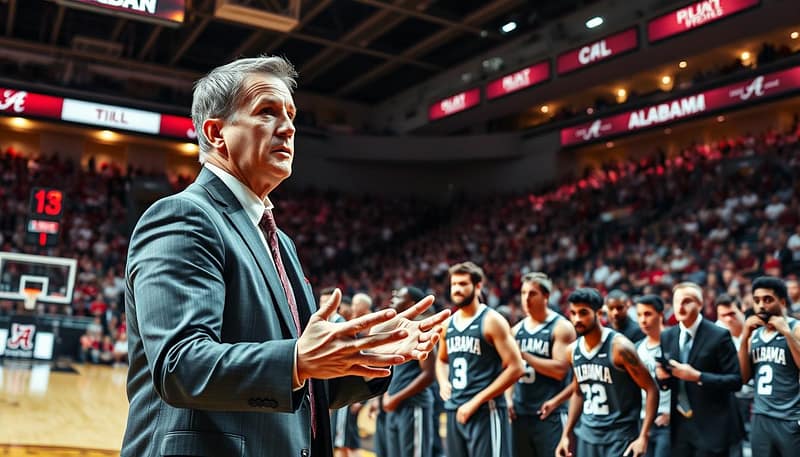
Oats’ offense is fast, like a Talladega race. His team won the 2023 SEC title with a focus on three-point shots. This approach helped freshman Brandon Miller become Alabama’s highest NBA draft pick ever.
What makes Oats stand out? Let’s look:
| Metric | Pre-Oats Era (2015-19) | Oats Era (2020-24) |
|---|---|---|
| Points per Game | 72.1 | 82.6 |
| NBA Draft Picks | 3 | 7 |
| SEC Titles | 0 | 2 |
Oats’ playbook is complex, like a Talladega tire pile. He uses four-out offenses to stretch defenses. His defense adapts quickly, like Tesla’s autopilot. This has led to 4 NBA players in 2023.
Oats makes analytics cool in a football-loving state. While others draw plays, Oats crunches numbers. He’s the only coach who quotes both Dean Smith and Saban’s defensive stats.
Leadership Styles and Program Building
If Alabama’s coaching legacy were a cocktail, it’d be two parts civil rights grit mixed with a splash of sequined jackets. The state’s basketball DNA is split between barrier-breakers and bench-showmen. CM Newton and Wimp Sanderson are perfect examples. Newton broke barriers, while Sanderson turned press conferences into shows. Both left lasting legacies.
Decatur’s gymnasium is special, honoring both a girls’ and boys’ coach. Jancy Morris and Earl Smith’s dual legacy shows the state’s coaching playbook. Morris’ girls ran full-court presses, and Smith’s boys mastered the pick-and-roll. Their 1,300+ wins show that success needs multiple leadership languages.
| Coach | Philosophy | Legacy Metric | Culture Blueprint |
|---|---|---|---|
| CM Newton | Civil rights through court vision | First integrated SEC roster | Silent consistency |
| Wimp Sanderson | Entertainment as strategy | 5 SEC Tournament titles | Controlled chaos |
| Jancy Morris/Earl Smith | Gender-equitable excellence | Dual-gender gym honor | Community-first ethos |
What connects Robert Horry’s 7 NBA rings to Leon Larker’s 988 NJCAA wins? Both came from Alabama’s coaching orchard. Larker’s teams were known for their defense, holding opponents under 60 points for 11 seasons. Horry, on the other hand, became the NBA’s ultimate clutch defender under Sanderson.
The real magic happens when these styles meet. Newton’s groundwork allowed Sanderson’s flair to shine. Morris/Smith’s focus on community helped Oats’ analytics-driven approach grow. Alabama’s all-time coaches share a common trait: they built programs that lasted long after they left. The best ones continue to shape the game’s future, one defensive stop at a time.
Impact on Player Careers
What do seven NBA rings and a women’s basketball revolution have in common? Alabama’s coaching DNA. The state’s hardwood history isn’t just about Xs and Os – it’s a career accelerator program disguised as college athletics.
Take Yolanda Watkins, the Diana Taurasi of Dixie. In the 1990s, her games at Decatur High became must-see theater. She routinely outdrew boys’ varsity matchups while averaging 28 points. Her 1994 season alone generated more local news coverage than Alabama’s gubernatorial race.
Coach Robertson’s motion offense didn’t just showcase her skills. It built a blueprint for Southern women’s hoops relevance.
On the men’s side, Robert Horry’s seven NBA championship rings clang with Alabama coaching echoes. His late-game heroics? That’s CM Newton’s “positionless basketball” philosophy – avant la lettre – meeting 90s NBA grit. Newton probably predicted modern spacing concepts while installing Coleman Coliseum’s first shot clock.
| Player | Era | Accolades | Coaching Influence |
|---|---|---|---|
| Robert Horry | 1992-2008 | 7× NBA Champion | Newton’s adaptive systems |
| Yolanda Watkins | 1990s | 3× HS All-American | Robertson’s offensive schemes |
| Brittany Davis | 2020s | WNBA Draft Prospect | Oats’ analytics-driven development |
Today’s pipeline keeps delivering. Watch 2023 SEC Freshman of the Year Brittany Davis – her catch-and-shoot efficiency screams Nate Oats’ spreadsheet basketball. WNBA scouts circle Tuscaloosa like hawks, tracking guards who play with Sanderson-era toughness and modern analytics discipline.
The real magic? Alabama coaches don’t just create players – they mint basketball archetypes. From Horry’s clutch gene to Watkins’ trailblazing swagger, these careers are living arguments for the program’s enduring influence.
Conclusion: Coaches as Crimson Tide Legends
Alabama basketball history is like the smell of bourbon at a Muscle Shoals recording session. It’s strong, lasting, and full of stories that stay with you. The program’s record of 1,794-1,101 wins is more than just numbers. It’s a mix of CM Newton’s fight for integration, Wimp Sanderson’s bold style, and Nate Oats’ use of data.
These coaches are like Appalachian legends. Their knowledge is passed down like recipes for moonshine. They teach the basics to future stars, from NJCAA to the SEC. Mark Gottfried’s 2004 Elite Eight run is like a campfire story, with David Hobbs’ clipboard playing the fiddle.
There’s a paradox here. Nick Saban’s statue is everywhere, but the basketball coaches are the real heroes. Avery Johnson brought NBA skills to recruiting. Sanderson made Coleman Coliseum a tough place for opponents. Their work lives on, as Mo Williams remembers Gottfried’s clutch plays and Robert Horry talks about Newton’s guidance.
The real magic is that these coaches created something lasting. Oats’ focus on three-point shots is like Bryant’s wishbone offense. Every drill today echoes the 1972 practices that changed Southern basketball.
So, if Saban gets statues, shouldn’t the court be named after a basketball legend? The answer is in Alabama’s 113 years of basketball history. It’s written in the sound of sneakers and the marks on dry-erase boards.