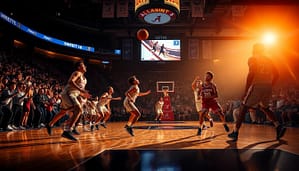
Tuscaloosa loves football, but Alabama basketball has a rich history. The team has won 1,821 games and made it to the 2024 Final Four. This shows there’s a lot happening on the court that we might have missed.
Imagine Robert Horry showing off seven NBA rings at parties. Or Collin Sexton becoming “Young Bull” in unforgettable moments. Alabama basketball is more than just football; it’s a place where heroes are made.
The team has made 25 NCAA tournament bids. The real question is, can Reggie King’s old-school style work today? Can 40 years of basketball history fit on one Mount Rushmore?
We’re focusing on the athletes who made Coleman Coliseum a place of greatness. These legends didn’t just play basketball; they redefined what it means to play in football country.
Introduction: Crimson Tide’s Storied Legacy
If college basketball had a Mount Rushmore of underappreciated dynasties, Alabama’s Crimson Tide would be a standout. It’s like Bruce Springsteen’s Nebraska album, full of grit and game-changing moments. This program didn’t just grow; it rebelled, blending cultural shifts with sports success.
In 1969, Wendell Hudson changed SEC basketball by becoming the first Black scholarship athlete at Alabama. He was a three-time All-SEC forward, setting the stage for future legends. In the 1980s, Wimp Sanderson’s teams were like jazz, full of structure and hard work.
Nate Oats brought a new era to Alabama basketball, combining analytics with boldness. His 2023 SEC title was a statement. The team’s “pace-and-space” style made them fast and unstoppable. And who saw the 2024 Final Four coming? It was like finding a unicorn at a Waffle House.
| Coach | Era | Record | Legacy |
|---|---|---|---|
| C.M. Newton | 1968-1980 | 211–123 | Integration architect |
| Wimp Sanderson | 1980-1992 | .692 win % | Plaid-clad philosopher |
| Nate Oats | 2019–present | 2023 SEC title | Modern disruptor |
Alabama basketball isn’t just for men. The women’s program has its own stars, like Jessica Breland and Brittany Davis. Their stories are often overlooked, but they’re just as important.
So why does this matter? It’s about more than just winning. It’s about the journey, the growth, and the passion. In Tuscaloosa, basketball is more than a game; it’s a zeitgeist in motion.
The Pioneers: Legends of the Early Era
Before analytics and viral mixtapes, Alabama basketball was built on muscle and southern charm. It was like Lynyrd Skynyrd on the court – raw, relentless, and full of sweat. These weren’t just players; they were craftsmen shaping the Mount Rushmore of Crimson Tide hoops.
Building Blocks of Bama Basketball
Reggie “Mule” King didn’t need protein shakes to average 20 points and 10 rebounds from 1976-79. He bench-pressed opponents like they were hay bales, dominating the paint with old-school conditioning. His secret? A diet of grits and a pull towards every loose ball.
TR Dunn redefined defense before steals became a stat category. With 749 career rebounds and quick hands, he turned Coleman Coliseum into his interrogation room. Opposing guards would wake up in cold sweats remembering his suffocating closeouts.
Buck Johnson was the mid-range assassin, shooting 58.3% from the field when jump shots were a rare skill. His game was like sweet tea: smooth, deceptively sweet, and Southern. Together, these titans formed one of Bama’s most iconic squads, proving teamwork beats talent when talent won’t box out.
Could these leather-helmet-era gladiators thrive today? Imagine King setting bone-crushing screens for modern shooters, or Dunn switching onto Steph Curry like a pitbull chasing a mailman. Their blue-collar ethos feels almost rebellious in today’s three-point circus – a reminder that championships aren’t always built on flash, but on foundations laid by calloused hands.
Game Changers: Sprewell, Horry and the NBA Bound
Robert Horry didn’t win 11 NBA rings by chance. He’s the ultimate backup plan in basketball. Alabama has given the NBA two unique stars: Latrell Sprewell, known for his explosive plays, and Robert Horry, the master of game-winning shots.
From Coleman Coliseum to Championship Pedigree
Before becoming a legend, Horry shot 37.1% from three at Alabama. Coaches saw a 6’9″ player with guard skills and energy. Latrell Sprewell, on the other hand, was a force to be reckoned with in the 1992 All-SEC season.
His drives were like NASCAR crashes, set to hip-hop beats. The NBA got exactly what it wanted from these players.
- Sprewell’s Chaos Theory: All-NBA honors and a chokehold on headlines
- Horry’s Swiss Army Knife: 7 championships across 3 franchises
- Bama’s Lasting Impact: 11 combined rings that could sink a pirate’s hand
Big Shot Rob’s Alabama Roots
Horry’s college stats were modest, but his pro career was anything but. Alabama’s system made him versatile, like a utility infielder. He could guard centers and shoot threes with ease.
When asked about his clutch gene, Horry said: “Tuscaloosa taught me pressure is just free adrenaline.”
Sprewell was a force in the 90s, known for his explosive plays. His 17.8 PPG average screams All-Star. His famous rant about needing to feed his family adds to his legend.
Modern Icons: Collin Sexton & Rising Stars
If Alabama basketball had a Spotify Wrapped, Collin Sexton’s 2018 season would top the list. It was a mix of chaos and rhythm that made opponents fear. Sexton averaged 19.2 PPG as a freshman, making Coleman Coliseum a viral sensation.
But Alabama’s success didn’t stop there. It’s now rewriting SEC history with a new era of talent.
The Nate Oats Effect
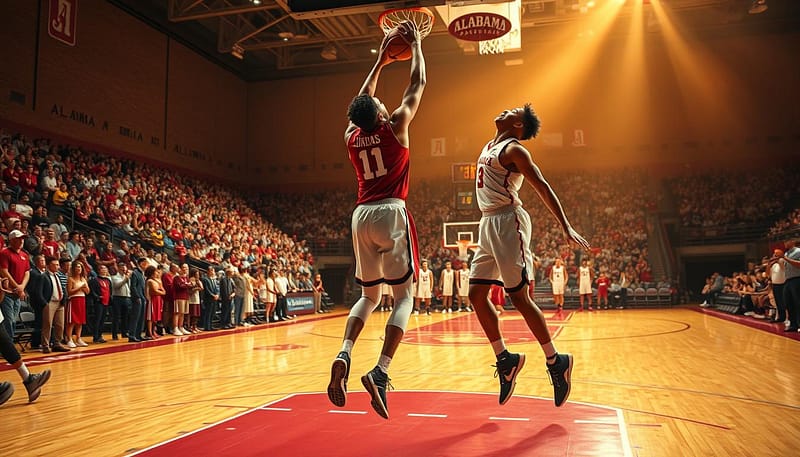
Nate Oats, the math teacher-turned-coach, has transformed Alabama basketball. His system focuses on shooting threes and defending fiercely. This approach has made Alabama a powerhouse, earning them the #1 tournament seed in 2023.
Brandon Miller’s freshman year was incredible, with 18.8 PPG and 8.2 RPG. He was like a “15-second highlight reel” that won a Wooden Award.
The Tide’s 2025 Sweet 16 win was a statement. Freshmen outscored upperclassmen 64–42. This raises questions about the system’s impact on basketball.
| Player | PPG | Breakout Season | Legacy Quotient |
|---|---|---|---|
| Collin Sexton | 19.2 | 2018 | “Human adrenaline shot” |
| Brandon Miller | 18.8 | 2023 | TikTok fame x Gym Rat |
| Cliff Omoruyi* | 14.1 | 2024 | McDyess 2.0? |
*Cliff Omoruyi is a 6’11” rim protector with a 58% field goal percentage in 2024. If he develops a mid-range game, the paint will be renamed “Cliff’s Edge.”
The SEC’s scheduling is also key. Tuesday night games against directional schools are not just warm-ups. They’re chances for freshmen to shine.
Alabama’s current roster is not just chasing championships. They’re trying to prove that basketball can outshine football. The question is, will they become legends or just a fleeting trend?
Unsung Heroes & Fan Favorites
Every championship team needs its Batman – but what about the Alfreds quietly resetting the Batmobile’s tire pressure? Alabama basketball’s legacy isn’t just in scoring titles. It’s in the sweat of defensive specialists and lunch-pail grinders who made Coleman Coliseum a house of hustle. These players are like IKEA instructions – confusing at first, but essential.
The Glue Guys of Crimson Lore
T.R. Dunn was like a human straitjacket, guarding three positions before positionless basketball was cool. His 1,247 career points were just a small part of his value. He held opponents to 39% shooting, like a bouncer checking IDs.
Richard Hendrix was a 58.3% FG% machine, making the paint a geometry lesson. His game was like Pythagoras, while others were doing algebra. Ronald Steele played through knee injuries like they were minor traffic delays, making assists with Swiss watch precision.
| Player | Stat Superpower | Signature Move |
|---|---|---|
| T.R. Dunn | 1.8 steals/game | Ball denial hypnosis |
| Richard Hendrix | 58.3% FG% | Post-up trigonometry |
| Ronald Steele | 4.9 assists/game | Injury-defying playmaking |
Modern glue guys like Herbert Jones make us question: Does locking down three positions nightly matter more than scoring 20 points? His 2021 SEC Defensive Player of Year campaign was like a silent film masterpiece. Current role players show that impact can be hidden, not flashy.
These aren’t just benchwarmers with good attitudes. They’re the backbone of championship dreams. They’re why “best Alabama basketball players” debates include defensive stats. A crown needs jewels, a spotlight needs a stage, and a bassline needs a beat.
Criteria for “Greatest”
How do you measure greatness in Alabama basketball history? Is it raw stats like a Zion Williamson dunk, or the stories that give you goosebumps? Let’s look at the Crimson Tide’s debate: cold analytics versus warm nostalgia.
When Numbers Tell Half the Story
Antonio McDyess played just 59 games for Bama but scored 18.4 points per game. Collin Sexton’s 28.7% usage rate in 2018 would make James Harden blush. But then there’s Leon Douglas, who scored 1,999 points and cleaned glass like Windex.
Modern metrics love flashy peaks. But career-long contributors are the bassline of Alabama basketball history. They’re essential but rarely spotlighted. Here’s a comparison:
| Player | Stat King | Storyline Champ |
|---|---|---|
| McDyess | 21.3 PER (1995) | 1st-round NBA pick |
| Douglas | 1,999 career points | 4 NCAA tournaments |
| Sexton | 29.1% assist rate | “3-on-5” legend |
| Whatley | 614 assists | 1982 SEC POY |
| Horry | 1.5 blocks/game | March daggers |
Robert Horry’s stats are solid. His NCAA tourney heroics are legendary. Ennis Whatley’s 8.2 assists per game in ’83 are a record – as reliable as a grandma’s cornbread recipe.
Alabama basketball legends aren’t just numbers. They’re time capsule moments – Sexton bleeding through 3 defenders, Horry draining clutch threes. But the analytics crowd might disagree.
So what’s your verdict? Does greatness wear a calculator watch or a storyteller’s cap? In Tuscaloosa, the debate rages hotter than a summer day at Dreamland BBQ. One thing’s certain – the best Alabama basketball players always leave us arguing…and that’s why we love them.
Lasting Impact on the Program
Alabama basketball is like a time capsule, where each era leaves its mark on the next. The program’s DNA now includes Charles Cleveland’s 1970s grit and Robert Horry’s clutch gene. Nate Oats’ analytics-driven approach has mixed these elements together. It’s like hoops evolution, with Darwin’s principles applied to basketball.
From Newton to Oats
Leon Douglas’ 1970s post moves are ancient compared to Brandon Miller’s modern skills. But Oats’ “3s or layups” mantra is influenced by both. Newton’s tough rebounding games helped today’s guards play with confidence. It’s like Newton’s third law in basketball, where every defensive rebound sparks an equal fast break.
Let’s look at the numbers behind Alabama’s change:
| Era | Playstyle | Signature Stat | NBA Pipeline |
|---|---|---|---|
| 1970s (Newton) | Power post offense | 52.3% 2PT FG | 2 draft picks/decade |
| 2020s (Oats) | Spread pick-and-roll | 38.6% 3PT attempts | 7 draft picks in 3 years |
The 2023 team’s 31 wins were not just historic; they were mathematically inevitable. Oats’ system turns three-star recruits into March Madness stars. When 2025 draft hopefuls study Latrell Sprewell’s drives, it’s not just nostalgia. It’s Gen Z learning from the past for their own viral moments.
But the big question is: Can Oats’ system win a championship? The 2024 Final Four run shows Alabama’s Moneyball with a southern accent approach is working. As NBA scouts watch Tuscaloosa, Alabama is proving you can teach old programs new tricks.
Conclusion: Legacy and Inspiration
Alabama basketball history is like a Quentin Tarantino movie – full of surprises and unforgettable characters. The Crimson Tide legends aren’t just names; they’re game-changers. Players like Newton, Sprewell, and Sexton changed the game without permission.
The 2024 Final Four is a big deal, promising greatness and challenging the status quo. Fluff Ratliff’s fame shows even bench players can leave a mark. Their stories are waiting for new fans to discover.
Arguing over the best Alabama basketball players is like a lively debate at Dreamland BBQ. It’s passionate and brings people together. Stats and stories are both important, just like Robert Horry’s rings and Collin Sexton’s “Man vs. Kentucky” game.
Keep an eye on newcomers like Derrion Sherrell and Naas Cunningham. They’re not just trying to fill the rafters. They aim to make a lasting impact, even catching Nick Saban’s attention. In Tuscaloosa, greatness is seized, not given.