What does it take to become collegiate royalty? At Alabama, it means etching your name into history with the subtlety of a sledgehammer.
We’re not just talking about making a list. We’re talking about the crimson-clad legends who redefined their sports.
Think Cornelius Bennett’s three-time football dominance. Dominique Canty’s four-time basketball brilliance. This is Alabama’s Mount Rushmore, if it had about 84 faces and counting.
From Johnny Mack Brown’s early gridiron heroics to modern legends like Derrick Thomas and DeVonta Smith, these athletes built the foundation of what makes Alabama synonymous with excellence.
They didn’t just collect honors. They created a standard that echoes through gymnastics mats, track fields, and hardwood courts.
Major Individual Awards
Winning individual honors is like graduating summa cum laude. It’s the difference between being great and being legendary. These trophies make mantelpieces shake with excitement.
Alabama’s award winners list is like a preview of the college football Hall of Fame. Mark Ingram’s 2009 Heisman Trophy was a big deal. It marked Alabama’s arrival at the top.
Derrick Henry won the Heisman in 2015, and DeVonta Smith in 2020. Bryce Young showed off his skills in 2021.
Defense has its own stars too. Derrick Thomas’s 1988 Butkus Award was a big win. Antonio Langham’s 1993 Thorpe Award showed that defense can shine.
Barrett Jones is a standout for winning multiple awards. He won the Outland Trophy, Rimington Trophy, and William V. Campbell Trophy. It’s like he won the academic-athletic hat trick.
- 2011 Outland Trophy (nation’s best interior lineman)
- 2012 Rimington Trophy (best center)
- 2012 William V. Campbell Trophy (academic Heisman)
Cornelius Bennett won the 1986 Lombardi Award. Kim Jacob won the 2014 Honda Cup. These show Alabama values excellence in all areas.
What do these trophies mean? They’re validation of greatness and the cherry on top. At Alabama, they’re both. These award winners had historic seasons that changed their positions forever.
SEC Player of the Year awards show Alabama’s dominance in the SEC. Winning these honors means beating the best in the conference.
These awards do more than sit in trophy cases. They’re part of Alabama’s recruiting lore and history. For these award winners, the hardware is just the start of their legacy.
Most Decorated Players
These Crimson Tide legends have trophy rooms that would impress any museum curator. They won big in sports, like winning an Oscar, Grammy, and Nobel Prize all at once. It’s like they excelled in every field they touched.
Barrett Jones was a master on and off the field. He won three national championships and was a two-time All-American. He also got many awards, like the Outland Trophy, and kept a 4.0 GPA. He was truly an overachiever.
Kim Jacob is another legend in gymnastics. She won 11 All-America honors and many other titles. It’s like she collected NCAA all-around titles and the Honda Cup like they were rare cards.
On the defensive side, Cornelius Bennett and Derrick Thomas shined. Bennett won three All-American awards and the Lombardi Award. Thomas was a unanimous All-American and won the Butkus Award and SEC Male Athlete of the Year.
What makes these Alabama athletes stand out? They didn’t just win awards; they set new standards in college sports. Their trophy cases are more than just collections; they’re symbols of talent and hard work.
These players are the peak of Alabama‘s championship culture. They make other programs look at Alabama‘s honors list and think it’s a sporting goods store’s inventory.
Award-Winning Moments
The difference between a good player and an award winner often comes down to 60 minutes of transcendent performance. In college football, awards aren’t handed out for participation – they’re earned when the spotlight burns brightest and legends are born.
Take Johnny Mack Brown’s 1926 Rose Bowl masterpiece. The man didn’t just play football; he conducted a symphony of destruction against Washington. Two touchdown receptions? In an era when forward passes were considered exotic? That wasn’t just an MVP performance – it was a declaration that Alabama had arrived on the national stage.
Then there was Don Hutson in the 1934 Rose Bowl. While everyone else was playing checkers, Hutson was playing 3D chess against Stanford’s secondary. His performance didn’t just win a game; it reinvented what was possible for receivers in college football. The man was so ahead of his time, he might as well have been playing a different sport.
Fast forward to Bear Bryant’s 1979 Sugar Bowl goal line stand against Penn State. Four downs from the one-yard line. National championship on the line. That wasn’t defense; it was architectural engineering – building an impenetrable wall of crimson when it mattered most. The Bear didn’t need speeches; he had goal line stands that spoke volumes.
Modern era? Mark Ingram’s 2009 Heisman campaign was a masterclass in narrative building. Every game felt like another chapter in a storybook season. His performance against Florida in the SEC Championship wasn’t just running; it was punctuation on a sentence that read “Give me the trophy.”
And who could forget DeVonta Smith in 2020? The man didn’t just play college football; he performed open-heart surgery on secondaries. His Heisman campaign was less about games and more about exhibitions of perfection. When he made LSU’s defense look like they were moving in quicksand, we weren’t watching football – we were witnessing art.
| Player | Season | Award | Defining Moment | Impact |
|---|---|---|---|---|
| Johnny Mack Brown | 1925 | Rose Bowl MVP | 2 TD receptions vs Washington | Put Alabama on national map |
| Don Hutson | 1934 | Rose Bowl Legend | Dominant receiving performance | Revolutionized receiver position |
| Bear Bryant | 1979 | National Championship | Goal line stand vs Penn State | Defensive masterpiece |
| Mark Ingram | 2009 | Heisman Trophy | SEC Championship performance | First Bama Heisman winner |
| DeVonta Smith | 2020 | Heisman Trophy | Record-setting season | Receiver Heisman breakthrough |
These moments share a common thread: they transformed individual excellence into collective memory. The best college football performances don’t just win games; they become cultural touchstones that define eras.
What makes these moments award-winning isn’t the statistics alone. It’s the context, the pressure, the stage. A hundred-yard game in September is nice; doing it when championships are on the line? That’s how bronze statues get made.
The magic of these performances lies in their permanence. Decades later, we’re talking about that goal line stand, that Rose Bowl dominance, that Heisman-clinching moment. In college football, greatness isn’t measured in yards alone – it’s measured in moments that become mythology.
Impact on Recruiting
What’s the most valuable currency in college football recruiting? It’s not NIL money or flashy facilities. It’s proof of concept.
Alabama’s trophy case isn’t just for show – it’s the ultimate sales brochure. When Nick Saban points to those three Heisman statues, he’s not selling dreams. He’s showing receipts.
The math is brutally simple for recruits: Alabama creates All-Americans. The program’s 18 national championships and 34 conference titles form a gravitational pull that’s nearly impossible to resist.
Think of it as athletic compound interest. Each All-American selection generates more interest from the next generation of talent. This creates a self-perpetuating cycle of excellence that would make Warren Buffett nod approvingly.
Current coaches don’t need elaborate pitches. They simply show the highlight reel: Heisman winners, Butkus recipients, and first-round picks who all wore the same crimson jersey.
The message isn’t “see what we have?” It’s “see what you could become?” That distinction separates good programs from legendary ones.
Professional success becomes the program’s best recruiter. When recruits see Alabama players dominating on Sundays, they understand the development pipeline is real. The All-American tradition isn’t history – it’s a promise.
This recruiting advantage explains why Alabama reloads instead of rebuilds. The program’s legacy acts as both magnet and amplifier, attracting talent while accelerating its development.
In the competitive marketplace of college football, Alabama doesn’t sell hope. It sells results. And the trophy case never lies.
What’s Next?
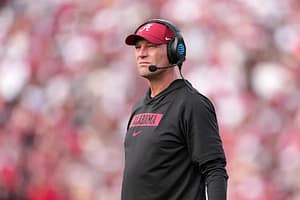
The Alabama football machine keeps rolling, even after the GOAT’s retirement. Nick Saban built a dynasty that became an award winners factory. Now Kalen DeBoer steps into the biggest shoes in college football.
Can he keep the conveyor belt of talent running? History suggests yes. The program’s infrastructure remains intact. The recruiting pipeline is always flowing crimson.
Recent history gives us clues. DeVonta Smith’s 2020 Heisman. Bryce Young’s 2021 trophy. These weren’t accidents. They were products of a system designed to create elite performers.
So who’s next in line for individual glory? Let’s examine the contenders:
- Jalen Milroe: The quarterback always sits in the Heisman cockpit. His dual-threat capability makes him a statistical monster waiting to happen
- Kadyn Proctor: Offensive linemen don’t win Heismans, but they do collect Outland Trophies. This mammoth tackle has that Outland Trophy chance
- Deontae Lawson: Linebackers thrive in Alabama’s system. Butkus Awards love Crimson Tide defenders
The real question isn’t if Alabama will produce more award winners. It’s how many and how soon. The program’s track record suggests we’re always one season away from the next superstar emergence.
Looking at the broader landscape, Alabama’s ability to develop talent continues to impact national recognition. The program consistently places players on prestigious lists like the NCAA All-American teams, demonstrating their ongoing dominance in player development.
DeBoer’s offensive genius at Washington showed he knows how to maximize talent. Now he’s working with better athletes than he’s ever coached. That combination could be terrifying for opponents and delightful for award winners committees.
The machine might have a new mechanic, but the blueprint remains unchanged. Develop five-stars into superstars. Turn talent into trophies.
Alabama doesn’t rebuild. It reloads. And the next wave of award winners is already on campus, waiting for their moment.
Conclusion
What do Alabama honors mean in college football? They’re not just trophies. They show a culture where excellence is expected, not just hoped for.
Alabama football is like the Ivy League of sports, but with Bear Bryant’s legacy. It doesn’t just find great athletes. It creates legends through tradition, pressure, and the Crimson Tide’s mystique.
These awards over nearly a century show college football’s top level. At Alabama, honors mark the journey to greatness, not the end. The program keeps pushing the bar, and everyone else watches.
The main point is: Alabama doesn’t just hope for greatness. It expects it. This expectation, based on decades of success, sets the Crimson Tide apart from others in college football.