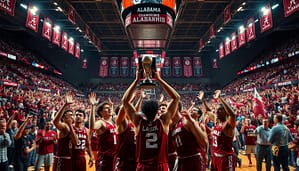
Alabama enters 2026 with a roster that looks different, younger in key places, and loaded with the kind of high-end talent that keeps Tuscaloosa from ever feeling like a rebuild town. The Crimson Tide lost stars to the NFL Draft, rebuilt pieces through recruiting and the portal, and now sit in that familiar Alabama pressure zone where “new-look roster” still means national title expectations.
That is the Crimson standard. The names change. The math rarely does.
Kalen DeBoer’s 2026 team has the bones of a deep College Football Playoff threat: a quarterback room with size and upside, a receiver group anchored by Ryan Coleman-Williams, a defensive backfield with NFL measurements, and a schedule that gives Alabama enough heavyweight games to build a title résumé before December—a combination that already has handicappers on sports betting forums circling the Tide as a dangerous futures play.
This roster is not built on nostalgia. It is built on matchup answers. Alabama has length at corner, size in the front seven, multiple body types in the backfield, and enough receiver variety to stress SEC defenses in different ways. That blend is why this season has a serious title-run feel, especially for a program that has already shown how a single dominant performance can reshape the mood around Bryant-Denny, much like the Crimson Tide defensive standard that defined Alabama’s 20-9 shutdown of LSU.
The Quarterback Room Has Size, Patience, And Real Competition
Every Alabama title conversation starts at quarterback, and 2026 is no different. The Tide no longer have Ty Simpson, who moved on after the 2025 season, so the room now turns toward Austin Mack, Keelon Russell, Jett Thomalla, Tayden-Evan Kaawa, John Gazzaniga, and John Cooper.
Mack is the veteran frame in the room at 6-foot-6 and 232 pounds, with prior Washington ties and multiple years in DeBoer’s orbit. Russell brings blue-chip intrigue from Duncanville, Texas, at 6-foot-3 and 201 pounds. Thomalla and Kaawa give the room more size, with Thomalla listed at 6-foot-4 and Kaawa at 6-foot-5.
That matters in DeBoer’s offense. The best version of Alabama in 2026 does not need a quarterback to cosplay as a superhero every Saturday. It needs a passer who can attack intermediate windows, protect the football on the road, and give the Tide’s receivers a chance after the catch. The roster has enough talent around the position that clean decisions may matter more than weekly fireworks.
The competition itself may become a strength. Alabama has enough quarterback options to let August sort out rhythm, leadership, and command. In the playoff era, depth at that position is not a luxury. It is survival equipment.
Ryan Coleman-Williams Gives Alabama A True Lead Receiver
Ryan Coleman-Williams is the name that makes defensive coordinators circle Alabama week on the calendar. Formerly known as Ryan Williams, the Saraland product is now listed on the 2026 roster as Ryan Coleman-Williams and wearing No. 1, a reset that fits the stakes of his junior season.
At 6-foot and 182 pounds, Coleman-Williams is not the biggest receiver on the roster, but he is the one with the brightest spotlight. His acceleration, body control, and open-field instincts give Alabama a first-read weapon who can flip field position without needing a perfect play call.
The difference in 2026 is that he does not have to carry the room alone. Lotzeir Brooks is listed as a sophomore at 5-foot-9 and 193 pounds. Rico Scott brings a 6-foot, 198-pound frame. Noah Rogers arrives with size and experience after stops tied to Ohio State and NC State. Cederian Morgan, a 6-foot-4 freshman from Alexander City, gives the Tide a big target with red-zone appeal.
| Offensive Piece | 2026 Class | Why It Matters |
|---|---|---|
| Austin Mack | R-Jr. | Veteran size and system familiarity at quarterback |
| Keelon Russell | R-Fr. | High-upside passer with room to grow into the job |
| Ryan Coleman-Williams | Jr. | Lead receiver and explosive playmaker |
| Lotzeir Brooks | So. | Slot speed and separation potential |
| Daniel Hill | Jr. | Power back profile at 6-foot-1, 236 pounds |
| AK Dear | R-Fr. | Young back with SEC-ready size |
| Marshall Pritchett | So. | 6-foot-5 tight end target with matchup value |
This is where Alabama’s roster construction starts to look dangerous. Coleman-Williams can draw coverage. Brooks and Scott can attack space. Rogers and Morgan can challenge smaller defensive backs. At tight end, Marshall Pritchett and Mack Sutter give the Tide big frames that can help in the run game and make defenses pay near the goal line.
The official Alabama 2026 roster shows the raw material. The title question is whether that material turns into a weekly passing identity by October.
The Backfield Can Be More Physical Than Flashy
Alabama’s running back room has a different feel in 2026. Jam Miller and Dre Washington are gone, which removes proven production, but the next wave has the size profile needed for SEC November football.
Daniel Hill is listed at 6-foot-1 and 236 pounds, the kind of back who can make second-and-6 feel manageable. AK Dear checks in at 6-foot-1 and 214 pounds. Kevin Riley brings a compact 5-foot-11, 198-pound build. EJ Crowell is a freshman at 5-foot-11 and 221 pounds. Khalifa Keith adds another big body at 6-foot-1 and 232 pounds.
That is a lot of weight coming downhill.
The Tide do not need the 2026 run game to look like a vintage Derrick Henry parade. They need it to punish light boxes. If Coleman-Williams and the receivers force defenses to respect width and vertical speed, Hill, Dear, Riley, Crowell, and Keith can turn Alabama into a team that wins late snaps. That is often the difference between a playoff team and a title team.
Deep title runs are rarely built on pretty September passing numbers alone. They are built on third-and-2 in Knoxville, four-minute offense against Georgia, and red-zone carries in Baton Rouge. Alabama has the bodies to win those snaps.
Defensive Length Gives The Tide A Playoff Profile
The defense may be the cleaner title argument. Alabama’s secondary is stacked with length, experience, and positional variety.
Keon Sabb is listed as a redshirt senior at 6-foot-1 and 208 pounds. Bray Hubbard is a senior at 6-foot-2 and 217 pounds. Zabien Brown is a 6-foot junior corner from Mater Dei. Dijon Lee Jr. is a 6-foot-4 defensive back from Mission Viejo. Red Morgan brings in-state grit from Phenix City. Zavier Mincey checks in at 6-foot-3. Ivan Taylor, Chuck McDonald III, Jorden Edmonds, Zyan Gibson, and Dre Kirkpatrick Jr. give the room even more competition.
That is not a normal collection of defensive backs. That is an Alabama answer sheet.
Modern playoff football demands corners and safeties who can survive tempo, tackle in space, carry vertical routes, and handle switch releases without panic. Alabama has enough long athletes to play man, mix coverages, and disguise pressure without asking undersized players to live in bad matchups.
The front seven has its own intrigue. Devan Thompkins, a 6-foot-5, 298-pound transfer from USC, gives the defensive line a grown-man presence. Fatutoa Henry brings size and experience with Oklahoma and junior-college background. Jah-Marien Latham, Yhonzae Pierre, Caleb Woodson, Luke Metz, Justin Hill, and Duke Johnson II give Alabama a linebacker/edge group that can rotate bodies through SEC heat.
| Defensive Piece | Position | 2026 Class | Title-Run Value |
| Keon Sabb | DB | R-Sr. | Veteran back-end control |
| Bray Hubbard | DB | Sr. | Size, tackling, leadership |
| Zabien Brown | DB | Jr. | Corner talent with big-game traits |
| Dijon Lee Jr. | DB | So. | Rare 6-foot-4 coverage frame |
| Devan Thompkins | DL | R-Sr. | Interior size after USC transfer |
| Yhonzae Pierre | LB | R-Jr. | Edge/linebacker pressure profile |
| Caleb Woodson | LB | Sr. | Transfer experience from Virginia Tech |
The roster is not short on answers. The playoff question is whether the pass rush arrives on schedule and whether the linebacker group replaces the old leadership voice fast enough.
The Schedule Gives Alabama A Championship Résumé Path
Alabama’s 2026 schedule is not gentle, but it is built for a national title run in one key way: the biggest games are spaced in a way that lets the Tide grow into themselves.
The season opens Sept. 5 against East Carolina in Tuscaloosa, then Alabama travels to Kentucky on Sept. 12. Florida State comes to Bryant-Denny Stadium on Sept. 19, followed by South Carolina on Sept. 26 and a road game at Mississippi State on Oct. 3.
Then comes the stretch that will define the season: Georgia at home on Oct. 10, Tennessee on the road Oct. 17, Texas A&M at home Oct. 24, LSU in Baton Rouge on Nov. 7, Vanderbilt on the road Nov. 14, Chattanooga at home Nov. 21, and Auburn in Tuscaloosa on Nov. 28.
That is a real SEC title résumé. Georgia at Bryant-Denny gives Alabama a national measuring stick. Tennessee in Knoxville tests composure. LSU in Baton Rouge always feels like a fistfight under stadium lights. Auburn at home gives the Tide a rivalry finish with playoff seeding pressure likely hanging over every snap.
The official Alabama 2026 schedule gives DeBoer’s roster a clear road map. Stack wins early, prove the defense against Georgia and Tennessee, stay healthy through late October, then hit November with enough momentum to chase Atlanta and the playoff.
Why This Roster Can Still Be Playing In January
Alabama’s 2026 roster is not perfect. The offensive line has turnover to settle. Quarterback must be solved. Receiver leadership behind Coleman-Williams must become weekly production. The front seven has to replace old names without losing old violence.
Yet the ingredients are there.
The Tide have a lead receiver who can scare the top off a defense. They have multiple quarterback options with size and upside. They have running backs built for SEC contact. They have a defensive backfield that looks like it was assembled to fight modern spread offenses. They have enough transfer experience to keep the roster from feeling too young, and enough freshman talent to raise the ceiling by midseason.
That is how deep title runs are made now. Not with one flawless unit. With enough answers to survive bad matchups.
By late October, Alabama should know what it has at quarterback. By November, the defense should have its rotation. By the Iron Bowl, the roster should either look like a playoff team or a team that missed its window. The talent says the first outcome is very much alive.
This is not Alabama asking for patience. This is Alabama reloading under a new shape.
The names are newer. The pressure is old. The standard has not moved an inch.
If the quarterback position settles and Coleman-Williams gives the offense a true No. 1 identity, Alabama’s 2026 roster has enough size, speed, and defensive length to make a serious national title push.