Can you name a Crimson Tide quarterback before Tua Tagovailoa? Exactly. This isn’t a program built on quarterbacks. It’s where glove-less gods and route-running savants make history. Long before Saban’s dynasty, Don Hutson was catching spirals barehanded in the 1930s.
Alabama’s receiver evolution is like the Fast & Furious franchise. Each era brings new excitement without losing the essence. David Palmer’s 90s jukes could’ve broken TikTok. Ozzie Newsome blurred tight end and receiver roles, making him a Swiss Army knife.
Yet, Saban’s NFL factory took it to 11. He turned Heisman Trophy winners like DeVonta Smith into human cheat codes.
What makes Crimson Tide wideouts different? They don’t just catch passes – they redefine them. From Hutson’s leather-helmet dominance to Smith’s 2020 masterclass, these playmakers turn end zones into art galleries. You’re not just watching football here. You’re seeing the sport’s DNA mutate in real time.
Pioneers of the Passing Game: Early Stars
Before the spread offense made football like a video game, Alabama’s passing game was truly radical. Imagine players in leather helmets running routes and teams throwing the ball more than twice a quarter. Don Hutson didn’t just play in this world; he changed its rules.
Hutson’s 1934 season was a game-changer. He scored 19 touchdowns in just 11 games. In a time when passes were rare, Hutson was scoring like Justin Jefferson. He basically created the wide receiver role we know today.
In the 1970s, David Bailey made the wishbone offense look like art. His stats were like flip phone numbers in today’s world. He outran defenders without the help of modern plays. Terrence Jones once said, “DJ Hall made magic look routine, but Bailey made routine look like witchcraft.”
These pioneers didn’t have TikTok or endorsement deals. But Hutson’s touchdowns were more than just scores. They were events that drew fans in. Imagine fans timing their bathroom breaks for his plays. It was like watching 80-yard sprints in wool jerseys.
Their impact? They shaped Alabama’s entire offense. The wishbone was a challenge to future coaches. “Go ahead,” it said, “try to ignore the passing game now.” But they couldn’t.
The SEC’s Premium on Receivers
The SEC is a place where football keeps getting better. Alabama’s change from slow to fast is a big example. Bear Bryant used to focus on running, but Steve Spurrier changed everything with his fast-paced offense.
Nick Saban then came along. He started with Trent Richardson’s running style. But when SEC defenses started stacking the box like Black Friday shoppers, he changed his plan. Tua Tagovailoa’s passing made Alabama’s receivers unstoppable.
This change didn’t just help Alabama. It changed the whole SEC. Now, every team needs top-notch wideouts. Recent rankings show SEC teams leading in receiving corps. Alabama’s program is the best at making receivers fast and precise.
Alabama’s coaches have made receiver training a key part of their program. They teach everything from routes to beating press coverage. This has made SEC receivers a big hit in the NFL draft, with 40% of first-round picks coming from the SEC.
The SEC’s competition is fierce, but SEC receivers are changing the game. They’re not just winning games; they’re changing how offenses play. Tuscaloosa, Alabama, is at the heart of this change, leading the way with fast and smart receivers.
Julio Jones: A New Standard
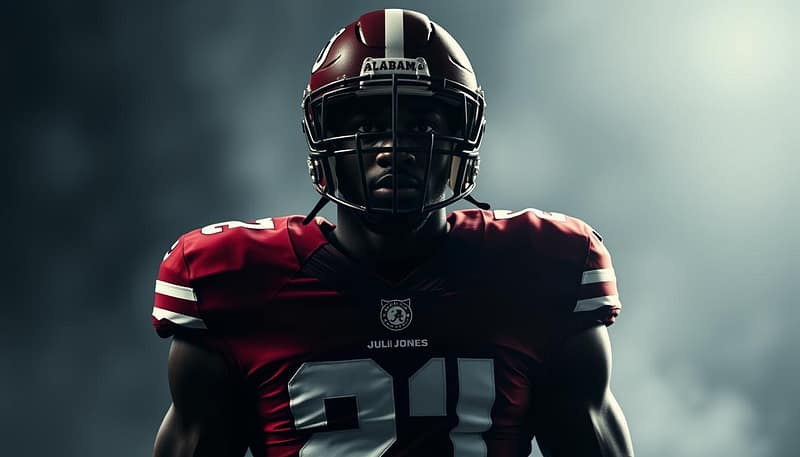
Julio Jones didn’t just play receiver at Alabama; he changed the game. His 2008 freshman season was like a blueprint for aerial warfare. He was a 6’3” cyborg with 4.39 speed, catching passes from Greg McElroy with uncanny accuracy.
Despite the challenges, Jones got over 1,000 yards. Let that sink in.
Modern analytics fans might say Julio’s stats are outdated. But his 58 receptions in 2008 were in a tough Alabama scheme. Defenses knew the ball was coming to Julio, but couldn’t stop him.
His signature play was a 9-route pass where he’d jump over three defenders. McElroy would pray to Bear Bryant’s ghost while doing it.
Fans debate if Julio’s 2008 season is as good as today’s stats. Calvin Johnson’s college best was 1,202 yards, but in 12 games. Jones did it in the SEC West with a QB who threw more interceptions than touchdowns.
The NFL took notice. Jones was the sixth overall pick in 2011, starting Alabama’s pipeline of first-round receivers. He changed Tuscaloosa from a run-first team to a pass-happy offense.
Among Alabama NFL players, he’s the gold standard. He had the same production as Megatron but with more stiff-arms and sideline moves.
Fun fact: Julio’s 2008 game film is a must-watch for Bama receivers. Current stars study his moves like jazz musicians study Miles Davis. The lesson? You don’t need 150 targets to be legendary; just give defensive coordinators nightmares.
Amari Cooper: Consistency & Class
Amari Cooper was like a silent assassin on the field. He was precise, efficient, and polite. His 2014 season was a masterclass in reliability.
Blake Sims, a converted running back, threw passes that seemed like Hail Marys. Cooper turned those passes into a symphony. He caught 124 passes for 1,727 yards, a feat that was truly remarkable.
Cooper was different from other receivers. He didn’t act like a diva. Here’s why:
- Route-running as performance art: His cuts were sharp and precise, like GPS-guided missiles.
- The business of excellence: While others celebrated with flair, Cooper was all about the spike. He did it 11 times in 2014.
- Record-book vandalism: Cooper left Alabama with 3,463 career yards, a record that stood tall.
| Season | Receptions | Yards | TDs |
|---|---|---|---|
| 2012 (Freshman) | 59 | 1,000 | 11 |
| 2013 | 45 | 736 | 4 |
| 2014 (Heisman Finalist) | 124 | 1,727 | 16 |
Cooper’s legacy at Alabama is more than just numbers. He redefined what a #1 receiver could be in Tuscaloosa. His 2014 Biletnikoff Award was a testament to his dominance.
Today, Amari Cooper’s NFL journey continues. His college tape is a must-watch. It shows how to beat press coverage and convert third-and-long.
In an era where drama is often mistaken for dominance, Cooper’s Alabama tenure proves greatness doesn’t need a microphone. It’s all about flawless footwork and hands that turn chaos into completions.
Calvin Ridley, Jerry Jeudy, Jaylen Waddle & Henry Ruggs III
Alabama’s receiver room from 2017-2020 was special. It created football constellations. Imagine combining Tyreek Hill’s speed with Antonio Brown’s routes and Randy Moss’s confidence. Multiply that by four.
This wasn’t just a depth chart. It was a battle against physics itself.
The 2017-20 Supernova Class
NFL scouts loved Tuscaloosa airport during these years. Here’s why:
- Calvin Ridley: A 2017 masterclass in precision, like Marvin Harrison with SEC flair.
- Jerry Jeudy: A 2018 gridiron Picasso. His routes were so complex, DBs needed GPS.
- Jaylen Waddle: A human cheat code. His 4.29 speed made crossing routes seem like ”Madden” glitches.
- Henry Ruggs III: A comet that burned too bright. His 2019 deep routes haunt DBs’ dreams.
| Receiver | Yards After Catch (Career) | 40-Yard Dash | NDP Draft Position |
|---|---|---|---|
| Ridley | 1,145 | 4.43 | 1st Round |
| Jeudy | 1,473 | 4.45 | 1st Round |
| Waddle | 1,208 | 4.29 | 1st Round |
| Ruggs | 1,068 | 4.27 | 1st Round |
Together, they had 4,894 YAC. That’s impressive. But they did it with one quarterback’s attention. Tua Tagovailoa’s 2019 season was a highlight reel of choosing which future millionaire to target.
Ruggs’ legacy is complex and haunting. His story after Alabama makes us think about football’s risks. Yet, on tape, he was pure lightning in cleats. The ultimate NFL draft pick paradox – unlimited talent in split seconds.
DeVonta Smith’s Heisman Season
In a sport where quarterbacks often get all the attention, DeVonta Smith changed the game. His 2020 season was like a work of art, with 117 catches, 1,856 yards, and 23 touchdowns. It was a season so incredible, it made Moneyball look like child’s play.

The Slim Reaper’s Magnum Opus
The LSU game was a turning point for Smith. He caught a deflected pass in mid-air, showing off his incredible skills. Analyst Timothy Gladney said Smith should be the only choice for Alabama Heisman winners. But why?
Smith was 170 pounds facing 130-pound SEC defensive ends. Yet, he was unstoppable, shredding defenses with ease. His secret was his advanced route IQ and reliable hands.
Smith’s Heisman moment was his entire season, not just one play. In a world dominated by quarterbacks, he proved that skill can conquer power. His performance against Ohio State was a statement: This is what happens when you weaponize precision against power.
Smith’s Heisman win didn’t just break records—it shattered them. For the first time in 29 years, a receiver won the top prize. He showed that even a “skill position” player can lead the way. Alabama’s legacy of producing NFL-ready receivers? Smith redefined it.
Record Holders & Clutch Performers
In Alabama’s playbook, pressure isn’t just a chapter—it’s the whole book. Stats shine in September, but legends are made in January. Let’s look at the receivers who made championship games their own personal highlight reels.
When Championships Were on the Line
DeVonta Smith didn’t just win the 2020 title game—he colonized it. His 12 catches for 215 yards and 3 touchdowns against Ohio State was more than a game. It was a takeover.
David “The Deuce” Palmer also made his mark in 1992. His 114-yard performance against Florida was like solving a Rubik’s Cube blindfolded.
Don Hutson dominated in leather helmets, while Smith played in modern times. But both had the same DNA. Kevin Norwood, Alabama’s captain, was a human safety valve. He made 4 catches for 78 yards in the 2012 BCS title game. His secret? Making Notre Dame DBs doubt their choices.
Why this matters:
- Hutson’s 1934 season: 8 TDs in 11 games (pre-modern passing rules)
- Smith’s 2020 run: 23 TDs in 13 games (against NFL-bound defenders)
- Palmer’s 1992 SEC title: 76% of Alabama’s offensive yards
These Crimson Tide wide receivers didn’t just play big—they redefined big. From Hutson’s heroics to Smith’s Heisman moment, Alabama’s legacy is in these moments. It’s when the universe says “clutch,” and they say “Roll Tide” with a stadium-shaking roar.
Changing the Offense: How Alabama Evolved
Imagine a football program changing from a typewriter to ChatGPT in mid-sentence. That’s what happened to Alabama’s offense under Bear Bryant. The Alabama passing game went from simple runs to complex passes. It’s like a Marvel movie transformation, from basic to advanced.
From Wishbone to RPO Symphony
Coaches started changing the game with new plays. Bill Curry introduced the I-formation in the ’80s, like a smartphone upgrade. But the big change came when Nick Saban hired new offensive coordinators like they were going viral.
Let’s look at the Alabama football coaches who changed the game:
- Lane Kiffin (2014-2016): He brought “YOLO Ball” with fast plays and 4th-down risks, making defenses question their lives
- Brian Daboll (2017): He mixed pro-style with college speed, creating a monster for defenses
- Mike Locksley (2018-2019): He made RPOs so smooth, they needed a jazz soundtrack
By 2020, Steve Sarkisian’s offense was like an NFL test run. Receivers ran complex routes, and quarterbacks read defenses like doctors. This led to a passing game that outscored most Arena Football League teams, but with better defense.
The final twist: Saban didn’t just keep up with football. He used it to his advantage. As one analyst said, “Bryant’s offense moved chains. Saban’s version downloads championships.” Alabama’s last decade saw more 1,000-yard receivers than the previous 50 years combined. That’s a record that will make history books spill their tea.
Impact in the NFL
If college football is America’s talent pipeline, Alabama might as well install a conveyor belt straight to the Pro Bowl. The Crimson Tide has produced 12 first-round NFL draft picks at receiver – a stat that turns even the New England Patriots’ old “Bama North” strategy into a punchline. But here’s the twist: When your alumni include human cheat codes like Julio Jones and track stars turned financial cautionary tales, the real drama happens after the combine hugs end.
Sundays Are Made in Tuscaloosa
Julio Jones didn’t just set the standard – he napalmed it. He has seven Pro Bowls, two All-Pro nods, and enough highlight-reel catches to make ESPN’s Top 10 his personal mixtape. Yet, his Hall of Fame debate lingers like a Nick Saban sideline glare. Why? Because while Julio’s 13,629 career yards scream “first-ballot,” his lack of rings whispers “Marty Schottenheimer” in Canton’s stuffy corridors.
Contrast that with Calvin Ridley, who parlayed a 1,346-yard 2020 Falcons season into a $92 million Jaguars payday… after a gambling suspension and a year-long hiatus. It’s the NFL’s version of buying Bitcoin at peak hype – risky, but someone’s gotta fund those Tuscaloosa statue budgets.
| Player | Draft Year | Career Yards | Financial Plot Twist |
|---|---|---|---|
| Julio Jones | 2011 | 13,629 | HOF debate vs. ring count |
| Henry Ruggs III | 2020 | 1,183 | Career derailed pre-2021 incident |
| Jaylen Waddle | 2021 | 3,385 | Dolphins’ $84M extension |
Which brings us to the uncomfortable question: Does this NFL dominance prove Saban develops pros… or just that he recruits mutants who’d thrive anywhere? Waddle’s 4.37 speed broke Dolphins records before his 23rd birthday. John Metchie III caught touchdowns months after chemotherapy. These aren’t projects – they’re pre-built weapons with SEC-tested warranties.
The truth? Alabama’s real NFL value isn’t in stats – it’s in scarcity. When 31 teams draft your receivers while muttering “We need our own DeVonta Smith,” you’re not just a program. You’re a luxury brand with shoulder pads.
Who’s Next? The Future of Alabama Receivers
The Crimson Tide’s receiver factory is buzzing with activity. It’s creating game-breakers at an incredible rate. Nick Saban is using the transfer portal like Amazon Prime to get top talent. This might make their 2017-20 class look old-fashioned.
The 2024 Pipeline
Ryan Williams is not just a prospect; he’s a game-changer. He has 4.4 speed and route-running skills that would impress even Cooper and Ridley. But there’s another player who might be even more exciting.
Here’s why this group could change the Bama receivers playbook:
- Kobe Prentice: The sophomore had a breakout in 2023 with 45 catches and over 700 yards. He’s like Ridley but with better skills.
- Jalen Hale: A 6’1″ player who can turn DBs into TikTok stars with his vertical threat.
- Transfer Portal Haul: Saban has added two Power 5 starters. He prefers to acquire talent instead of developing it.
| Name | Speed (40 yd) | Playstyle | NFL Comparison |
|---|---|---|---|
| Ryan Williams | 4.42s | Elusive YAC Artist | Tyreek Hill Lite |
| Kobe Prentice | 4.38s | Route Technician | Calvin Ridley |
| Jalen Hale | 4.49s | Deep Threat | Mike Williams |
While the NIL collective sends Venmo notifications fast, one thing is clear. Alabama doesn’t rebuild at receiver; they upgrade. The real question is, how many records will they break before Saban changes the WR meeting room?
Conclusion: Lasting Influence
Alabama wide receivers did more than just catch passes. They changed the face of college football’s greatest program. From Don Hutson’s early days to DeVonta Smith’s Heisman win, they left a mark. Today, they are the spark that makes Alabama football shine.
The program’s legacy is built on both air raids and ground attacks. Julio Jones and Amari Cooper showed the world what’s possible. Their skills set new standards, making fans and scouts alike take notice.
This growth is not just about the past. It’s a blueprint for the future. NFL Sundays often feature Alabama’s wide receivers. They’ve turned a program known for its toughness into a hub of offensive creativity.
So, let’s talk about the best seasons. Was it Smith’s 2020 or Cooper’s 2014? Or maybe Ridley’s footwork is better than Jeudy’s releases? This debate is what makes Alabama football special. It’s a place where every play can start a new legend. Who will be the next star? Pass the cornbread.