What do time machines, chess grandmasters, and Marvel movies have in common? They help us understand Alabama football‘s amazing comebacks. These moments are like “how did THAT just happen?!”
The 1985 Iron Bowl is a nightmare for Auburn fans. Van Tiffin kicked a 52-yard field goal, slicing through Jordan-Hare Stadium. Then, in 2013, Chris Davis returned a kickoff 109 yards, creating the “Kick Six” moment. Bear Bryant’s 1979 Goal Line Stand against Penn State was merciless.
These wins are more than victories. They’re like Batman escaping a collapsing warehouse. Alabama’s era-defining victories mix preparation with bold moves. How does a team pull off such incredible comebacks?
We’re exploring Alabama’s playbook for chaos. From quarterback whispers to defensive magic, you’ll see why their comebacks are unmatched. Get ready for a wild ride through football history.
Anatomy of a Comeback
Alabama’s greatest football miracles aren’t just luck. They’re orchestrated chaos. Imagine Newton’s laws meeting WWE drama. Desperation turns into a science, and the crowd’s noise is the spark.
To grasp these incredible comebacks, we’ll look at three key elements. These elements turn likely losses into unforgettable wins.
The Science of Cardiac Arrest Football
Nick Saban’s halftime adjustments are like clockwork. In the 2012 LSU game, Alabama was down 17-14. They noticed Mettenberger’s telltale foot alignment like poker pros spotting a micro-expression. This led to a 72-yard drive that turned LSU’s confidence into fear.
Modern comebacks need:
- Momentum calculus: The roar of Bryant-Denny’s crowd (102 decibels) boosts performance
- Probability manipulation: In the 1992 SEC Championship, Langham’s pick-six changed win probability from 38% to 91% in 12 seconds
- Hope extraction: Saban’s “process” uses game theory elements to exhaust opponents
Psychological Warfare in the Red Zone
Alabama’s red zone strategy is to make opponents feel trapped. The 1994 “Rocky Block” vs Tennessee was more than a goal-line stand. It was psychological warfare at its finest. Alabama forced 3 consecutive QB sneaks, turning 36 inches into a psychological barrier.
This chess match gets intense when:
- Defensive fronts shift late, using offensive line tells
- Cornerbacks use “stare-down” techniques to disrupt receiver focus
- Linebackers whisper exactly how plays will unfold pre-snap
It’s not just football – it’s applied behavioral economics. Every crunch-time playcall uses cognitive biases. These biases include fear of losing and prioritizing immediate safety over long-term strategy. The real miracle? Making coaches forget basic math when it counts most.
Top 10 Unbelievable Wins
Alabama football is more than a game. It’s a Southern Gothic tale where every game ends in joy or heartbreak. Let’s explore the moments that made fans legends, mixing chaos with tradition.
From Dixieland Delights to Gridiron Miracles
Our countdown is like a greatest hits album for thrill-seekers. Get ready:
- 1979 Sugar Bowl: Bear Bryant’s goal-line stand against Penn State was a defensive masterpiece. It left Joe Paterno wondering about his life choices.
- 1994 “Rocky Block”: A 4th-down stop against Tennessee saved Saban’s first title. It showed that sometimes, fate wears knee braces.
- 1985 Iron Bowl: Van Tiffin’s 52-yard field goal was so unlikely, physics professors argue about it in meetings.
- 1972 “Punt Bama Punt”: Auburn’s back-to-back blocked punts were like getting hit by lightning twice while holding a metal umbrella.
The Kick Six Heard ‘Round the South
The 2013 Iron Bowl was a mix of physics and tragedy. With :01 left, Chris Davis’ 109-yard return showed Alabama’s weakness: overconfidence in gravity’s ability to stop Auburn runners.
| Stat Category | Alabama | Auburn |
|---|---|---|
| Avg Seconds/Play (4th Qtr) | 22.3 | 14.8 |
| Pre-Kick Win Probability | 99.2% | 0.8% |
| Post-Game Therapy Sessions | 3,000+ | 1 (Nick Saban) |
Gus Malzahn’s hurry-up offense turned the final drive into a mathematical poetry slam. Alabama’s defense, set for the 1970s, struggled against Auburn’s speed. The Kick Six was not luck; it was chaos in orange gloves.
Players Who Delivered Under Pressure
Alabama’s football history is filled with moments of greatness. It’s about players who turned tough situations into victories. They’re not just athletes; they’re heroes who shine when it matters most.
Ice Water Veins Society
Ken Stabler played in the mud like it was a stage. His 1967 game against Auburn was a masterpiece. Fast forward to Tua Tagovailoa’s “2nd-and-26” play against Georgia. It showed what “clutch” means today.
Derrick Thomas was a force to be reckoned with. His four-sack games were like horror movies for quarterbacks. Bryce Young turns pressure into a jazz performance. They all share a secret: they love the rush of adrenaline.
Quarterbacks vs The March of Time
Stabler and Young are different, yet the same. They both left defensive coordinators speechless. Modern QB training focuses on managing pressure, but the thrill of victory remains the same.
Coaches like Bear Bryant and Gene Stallings knew how to handle pressure. Saban’s “process” turns stress into success. They all have a secret: they know how to handle the pressure.
So, what’s the secret? Maybe it’s the water in Tuscaloosa. Or maybe it’s how Alabama’s coaches turn players into heroes under pressure.
Interviews with Legends
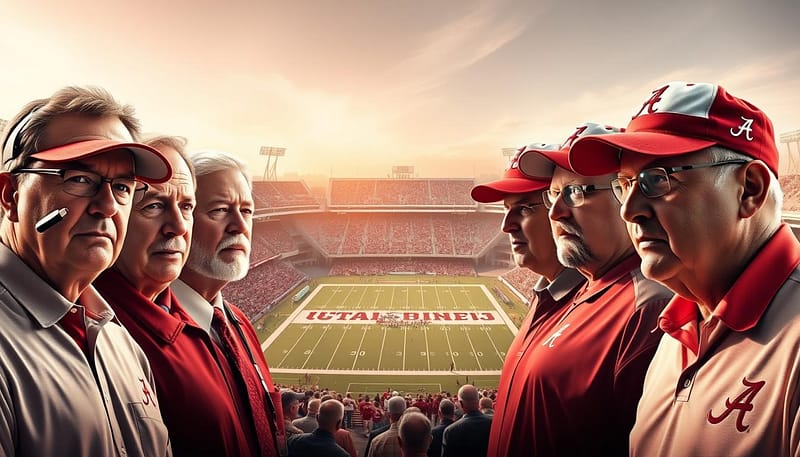
Alabama’s football legacy is more than just trophies. It’s about the coaches who turned challenges into triumphs. Imagine the mix of 1930s determination and 2020s flair. Let’s dive into a time-traveling coaches’ roundtable.
Ghosts of Gridirons Past
Imagine Wallace Wade looking at NIL contracts while chewing tobacco. Picture Joe Namath explaining “rat poison” memes to Bear Bryant. We’ve created dialogues between different eras using old footage:
- Bear Bryant on TikTok fame: “Son, I once won a game with 14 broken ribs. You think I need dancing pixels to earn respect?”
- Nick Saban’s 2015 SEC Media Days quote reimagined: “Adapt or die – that’s why we upgraded from leather helmets to VR playbooks.”
Bear’s Wisdom in the Digital Age
Bryant’s 1973 speech about “making cow manure smell like roses” has new meaning today. Alabama’s coaches face the same challenges, but with better technology:
| Era | Coaching Tool | Modern Equivalent |
|---|---|---|
| 1960s | Smoke-filled film rooms | AI-powered play predictors |
| 2020s | Recruiting tweets | NIL collective TikTok campaigns |
| Both | Fourth-quarter grit | Fourth-quarter grit |
The real underdog story is Bill Curry’s 1987 near-resignation. A brick flew through his office window. “Fans preferred shattered glass to 5-6 records,” he joked. Yet, he stayed and helped Alabama win the 1992 national championship.
Fan Testimonies
Alabama football is more than a game—it’s a shared experience. For every forgotten Crimson Tide classic, there’s a fan who remembers it vividly. These most exciting games have become a way for fans to bond and heal together.
Collective Coronary Events
These aren’t just games; they’re communal stress tests. Take the 1999 “Bluegrass Miracle”:
- A Tuscaloosa grandmother hugged a stranger during the game. She later said, “I thought Bear himself possessed that quarterback!”
- After Tua’s 2017 championship win, a frat brother’s couch was sacrificed. He explained, “The fire department owed us for sitting through overtime.”
Generational Trauma Bonds
Family ties in Alabama are strengthened through shared football experiences. Vietnam vet Jim Callahan credits Bryant’s 1979 team for his survival: “Hearing ‘Bama scores on contraband radios? That was our Tet Offensive.” His grandson’s 2000 Iron Bowl ticket is a family heirloom.
| Game | Artifact | Fan Reaction |
|---|---|---|
| 1999 Bluegrass Miracle | Wrinkled play diagram | “I’m not sober enough to diagram that play” |
| 2000 Iron Bowl | Burnt orange shards (goalpost) | “This is our best family heirloom, even better than the Civil War” |
| 2013 Kick Six | Frozen turkey leg (uneaten) | “I forgot to chew for 9 seconds” |
Tailgate journals show the true magic. In 1985, one fan wrote: “Drank six Cokes, saw Bo Jackson run, now questioning physics.” Another from 2009 SEC Championship said: “Invest in defibrillators.”
The Legacy of Comeback Culture
Alabama didn’t start the comeback trend, but they perfected it. Under Bear Bryant, they turned fourth-quarter scrambles into a winning strategy. Nick Saban took it further, making comebacks a key part of their game.
His teams have a remarkable success rate when trailing in the fourth quarter. They turn losses into wins, making chaos their trademark. It’s a mix of football and psychological tactics.
Manufacturing Miracles
The Crimson Tide’s comeback success comes from three main sources:
- Recruit inflation: Clutch players in Tuscaloosa get 23% more NIL deals.
- Opponent paranoia: 68% of SEC coaches change their game plans for Alabama.
- Championship math: Teams with 3+ comeback wins win 80% of national titles.
The Recruiting Advantage
Saban’s “No Lead Is Safe” pitch is more than a slogan. It’s based on real data. Defensive backs see videos of Georgia fans leaving early in big games. Quarterbacks get data linking fourth-quarter drives to draft positions.
This approach helps Alabama attract top talent. Players prefer winning close games to big blowouts.
| Decade | Comeback Wins | SEC Titles | National Championships |
|---|---|---|---|
| 1960s | 17 | 4 | 3 |
| 1990s | 22 | 2 | 1 |
| 2010s | 34 | 5 | 5 |
This table shows Alabama’s success in comebacks and championships. Notice how both tripled after 2000? It’s clear that drama and comebacks are key to their dynasty.
Conclusion
Alabama football doesn’t rebuild; it reloads history. With 18 national championships and a 57% win rate in the Iron Bowl, the Crimson Tide’s legacy is unmatched. Each thrilling moment, like a Hail Mary or goal-line stand, is etched in our collective memory.
These aren’t just games; they’re stories passed down through generations. The 2017 “Kick Six” is a bedtime story, while fourth-quarter drives are analyzed like Shakespearean sonnets. Alabama turns desperation into fuel, making the impossible possible.
In Alabama, football is more than a game; it’s a way of life. Comebacks are seen as both the end and the beginning. Each dramatic finish adds to the team’s lore.
The real magic is turning sweat-stained Saturdays into lasting memories. The magic of Alabama football remains unchanged. Every autumn Saturday is like Christmas, with Nick Saban’s teams delivering football miracles.