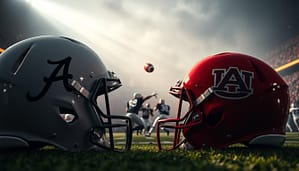
Let’s explore the idea of immortality in football. When a player’s name is etched into history, it’s a moment of greatness. This honor marks a shift from a mere career to a legendary status.
At Alabama, the balance between individual achievements and team legacy is fascinating. They have 15 national championships and a coaching dynasty. Yet, only one Heisman Trophy winner, Mark Ingram, is celebrated. His win in 2009 was by a narrow margin, fitting for a team that values teamwork.
But sometimes, the unexpected gets recognized. William Amelong, for example, isn’t a household name at Alabama. Yet, his induction into the Long Beach City College Hall of Champions shows the power of legacy. He played in the 1990 Sugar Bowl, a game they lost. Yet, decades later, he was honored at his junior college, calling it a reunion.
Induction is about creating lasting reunions in sports. Whether it’s the first class of seventeen or a local hero like Amelong, it’s a way to say your story is forever part of the narrative. This transformation of hard work and skill into lasting heritage is what we’re exploring.
Multi-Sport Icons
We often focus on athletes, but there’s another group of legends: the officials who know many sports. The Alabama Sports Officials Hall of Fame shows us a different kind of athlete. What if the true polymaths were the ones making sure the game was fair?
Players are judged by their stats, but officials are judged by fairness. They understand sports deeply, not just by playing them. Their skill is in knowing the rules, not just in physical ability.
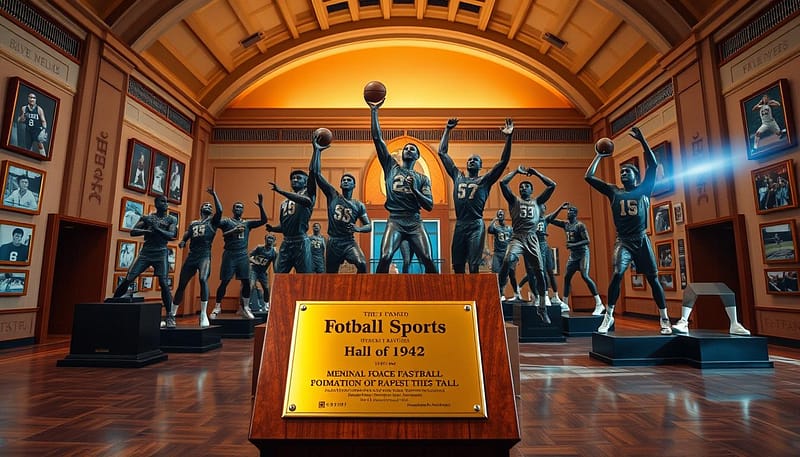
Bobby Brock is a great example. He worked in basketball and football at high school and SEC levels. He officiated games with stars like Pete Maravich and Artis Gilmore. The SEC trusted him with their biggest games.
He retired to care for his wife, showing his true character. Brock was a top official, choosing to leave at his peak for family.
Pat Adkison worked in seven sports. He helped organize Alabama’s first softball state championship and called games for a NCAA Division II baseball title. He was more than a referee; he was a builder.
Adkison’s work helped others become stars. He’s a different kind of top player, working behind the scenes.
| Official | Sports Officiated | Career Highlights | Legacy/Impact |
|---|---|---|---|
| Bobby Brock | Basketball, Football | SEC-level official for marquee games; worked contests featuring Pete Maravich & Artis Gilmore | Exemplified integrity; retired at peak to care for family, showing officiating as a calling beyond sport |
| Pat Adkison | 7 AHSAA Sports (incl. Softball, Wrestling, Baseball) | Instrumental in first AL softball state championship; officiated NCAA D-II baseball national title | Administrative pioneer; built structures for sports to thrive, a true architect of the game |
| Larry Galloway | Baseball, Football | 46-year career spanning three states; consistency across decades and regions | Embodied longevity and adaptability; mastered the art of the fair call across generations |
Larry Galloway worked for 46 years. He officiated in baseball and football across three states. His career shows how to stay consistent in a changing world.
These officials are not just specialists. They are Renaissance men and women. Their work challenges our idea of what it means to be a multi-sport icon.
In our focus on athletes, we overlook the officials. They don’t get fame, but they earn respect. The Alabama Sports Officials Hall of Fame celebrates these unsung heroes.
Fan-Voted Favorites
Forget marble plaques and selection committees; the truest Hall of Fame often has its polls open 24/7. This is the realm of the fan-voted legend, a digital pantheon built on pure, unfiltered sentiment. Think of it as a political primary for athletes, but the debates are fiercer and the platform is a ranked list.
Our case study? A massive Ranker poll where over 8,100 voters have passionately argued over the greatest Alabama football players. The instructions are beautifully democratic: “If you notice someone is missing… feel free to add him.” It’s an open invitation to rewrite history, or at least to start a beautiful fight in the comments.

This process creates a fascinating, parallel canon of heroes. The fan-voted favorite might not have the shiniest NFL trophy. His claim to fame is visceral. It’s that game-saving tackle against Auburn in a year that meant everything. His induction is powered by memory, not just metrics.
So, what defines a fan-voted Hall of Famer? It’s less about cold stats and more about:
- Cultural Moment: They are forever tied to a specific, iconic play in team lore.
- Emotional Resonance: Their story or style forged a deep, personal connection with the fanbase.
- Underdog Appeal: Often, they represent the triumph of heart over pure athleticism.
This crowdsourced Hall of Fame asks a profound question. Does legitimacy come from a formal plaque, or from the sustained, collective voice of the faithful? In places where a sport is less a pastime and more a shared religion—like Alabama football—the fan vote isn’t just a poll. It’s a sacrament.
The contrast is stark. Official institutions rely on established criteria for greatness. The digital agora operates on love, nostalgia, and sometimes, glorious bias. One gives us history. The other gives us heartbeat.
Impact on Team Legacy
What makes a program iconic? It’s not just trophies. It’s the stories we keep telling.
Every induction ceremony adds to a massive tapestry. Legends like Bear Bryant and Nick Saban are more than wins. They built an ecosystem. Officials like Wilmer Sigler Sr. mentor the next generation.
These rituals turn individual achievements into a shared myth. The honored player becomes a chapter. The ceremony is a reunion, connecting past and present, as William Amelong noted.
This is how you build program legends. It’s not just recording history. It’s making it a living genealogy. Each induction tells new recruits: excellence here is not forgotten. It’s enshrined.
The impact is beautifully recursive. Legends define the program’s legacy. Adding new ones keeps that legacy alive. It’s not about the individual on stage. It’s about the program’s ongoing epic story. That’s how legends endure.