Here’s a riddle: What does a football coaching search have to do with basketball success? In 1968, Bear Bryant almost hired Bobby Knight. This almost-hire sparked a basketball awakening in Tuscaloosa.
The program’s history is like a paradox. It has nine NBA championship rings but its last Final Four win was in 2004. You can see this mix at the Bryant Museum, where basketball and football coexist.
How does a football-first school produce stars like “Big Shot Rob” Horry? Or SEC Player of the Year contenders who shine in March Madness? It’s a unique blend of sports.
This isn’t just about sports. It’s about culture and passion. The Tide’s basketball journey shows how football and basketball can come together. Even Bear Bryant might have cheered for basketball.
Introduction: Early Days
Before “Roll Tide” became a basketball chant, two men changed Alabama’s court. They brought social progress and SEC success. C.M. Newton, from Kentucky, and Wendell Hudson, a Black pioneer, started a cultural experiment in 1969.
Newton, from Kentucky’s Adolph Rupp tree, was a big change. He hired Hudson, Alabama’s first Black scholarship player. Together, they won three SEC titles in eight years, breaking sports apartheid.
The numbers show their impact:
| Metric | Pre-Newton Era (1950-1968) | Newton/Hudson Era (1969-1980) |
|---|---|---|
| SEC Championships | 0 | 3 |
| All-American Players | 1 | 4 |
| NBA Draft Picks | 2 | 7 |
Newton saw integration as a chance, not a problem. Basketball became Alabama’s progressive side. Hudson’s game opened doors for future Black athletes in the SEC.
This was more than team building. It was building cultural infrastructure. The crowds grew, the plays got better, and the wins piled up. By 1976, Newton’s teams had more SEC titles than Bryant’s football teams.
But history often overlooks these historic teams. They are the quiet revolution in Alabama basketball tradition. They are worth remembering.
Growth Through the Decades
The Crimson Tide’s playbook in the 80s and 90s was full of surprises. Wimp Sanderson’s plaid jackets were as famous as Springsteen’s leather. His 276 wins made Alabama a top team in the SEC and a place for NBA stars.
Recruiting was like a secret mission. Stealing Latrell Sprewell from New York was like taking Picasso’s brush. Derrick McKey’s move from Mississippi was like a Ocean’s Eleven heist. These players changed Southern basketball forever.
| Decade | Signature Move | Wins | NBA Exports |
|---|---|---|---|
| 1980s | Sprewell/McKey recruiting coups | 142 | 9 |
| 1990s | McDyess era dominance | 134 | 5 |
| 2000s | Gottfried’s Elite Eight run | 98 | 3 |
Antonio McDyess dominated in the mid-90s. He scored 20.1 points and grabbed 10.6 rebounds per game. In 2004, Mark Gottfried led the team to an Elite Eight win. This moment changed how people saw Alabama basketball.
Alabama won four SEC titles in twelve years. This wasn’t just growth – it was taking over the territory. The program went from underdog to conference leader. Each NCAA tournament run helped Alabama find its place in basketball.
Landmark Teams & Classic Games
What do a 1991 team called the ‘Roughnecks’ and a 2023 team with a freshman star have in common? They both brought chaos to Alabama basketball. Both teams showed how to win big with raw energy and breakout seasons.

The ‘91 team had NBA stars Latrell Sprewell and Derrick McKey. They played with a burst of energy, winning 23 games and reaching the SEC Tournament finals. Thirty-two years later, Brandon Miller’s team showed the same intensity, winning 31 games.
- 1991 Roughnecks: Sprewell’s 17.8 PPG • McKey’s 55% FG • SEC West champs
- 2023 Freshman Force: Miller’s 19 PPG • 8.2 RPG • SEC Tournament MVP
Robert Horry was a game-changer in 1992, dunking on Shaq and winning 7 NBA rings. His famous dunk against LSU was just the start of his clutch performances. The 2020 team, canceled by COVID, might have been his spiritual successor. We’ll never know.
| Era | Signature Move | NBA Pedigree | Lasting Impact |
|---|---|---|---|
| 1990s | Horry’s rim-rattlers | 14 combined seasons | SEC relevance restored |
| 2020s | Miller’s stepbacks | 3 lottery picks | Final Four blueprint |
These teams show Alabama’s knack for creating historic teams. From Horry’s championships to Miller’s freshman year, the Tide keeps making history. They do it with each new generation of talent.
Key Rivalries
Why do basketball games need referees and boxing gloves? The Alabama-Auburn rivalry shows us. It started as a football feud but now it’s a drama-filled basketball showdown. Imagine the power struggles and big egos, like in HBO’s Succession.
The 1983 “Punch Heard ‘Round Dixie” is a legendary moment in college basketball. Alabama’s Ennis Whatley and Auburn’s Charles Barkley had a fight. It was like Ali-Frazier, but in Dixie. The real score was 1 knockout, 2 technicals, and endless replays on Birmingham TVs.
Bruce Pearl’s time at Auburn has changed Alabama basketball. He brought in top talent, making the Iron Bowl a key recruiting spot. Here are some key moments:
| Era | Alabama’s Weapon | Auburn’s Counter | Biggest Win Margin |
|---|---|---|---|
| 1980s | Ennis Whatley (Fists) | Charles Barkley (Jaw) | +1 Black Eye |
| 2020s | Brandon Miller (3-PT) | Jabari Smith (Dunks) | +18 Points (2023) |
Pearl made Auburn a force in Alabama basketball. His 2019 Final Four run was a big deal. It made Alabama fans go crazy.
Today’s games are intense, with top players on both sides. The rivalry is as fierce as ever. When Alabama’s Nate Oats faces Auburn’s Tigers, it’s a battle for the best players.
SEC Dominance
Alabama’s SEC dominance is more than just a streak. It’s a fast-paced chess match. With 13 conference titles and a 16-2 conference record recently, they’ve set a new standard for success. But there’s a twist: their basketball tradition is built on two very different philosophies.
Wimp Newton’s motion offense is like the 1980s Lakers. Nate Oats’ “pace-and-space” system is like the Golden State Warriors. This mix creates a fascinating study in how to adapt:
| Era | System | SEC Win % | March Results |
|---|---|---|---|
| Newton (1981-1999) | Methodical Motion | 72% | 3 Sweet Sixteens |
| Oats (2019-Present) | Pace-and-Space | 78% | 1 Final Four |
| Kentucky (Last Decade) | Blueblood Hybrid | 68% | 2 Championships |
Let’s look at the numbers. Over the last decade, Alabama’s .744 conference win rate beats Kentucky’s .712. This fact might surprise even Coach Calipari. But the question remains: Does winning the SEC leave enough energy for the NCAA Tournament?
The data shows a paradox. Oats’ system has better regular-season results than Newton’s but has only produced one deep March run. Kentucky, with a lower SEC win percentage, has won more championships. Is this the basketball version of the “regular season vs. playoffs” debate?
Yet, Alabama’s basketball tradition keeps evolving. From Newton’s defensive focus to Oats’ three-point attacks, they keep winning conference titles. The challenge is to turn these wins into national championships without losing their identity.
Tournament Triumphs and Challenges
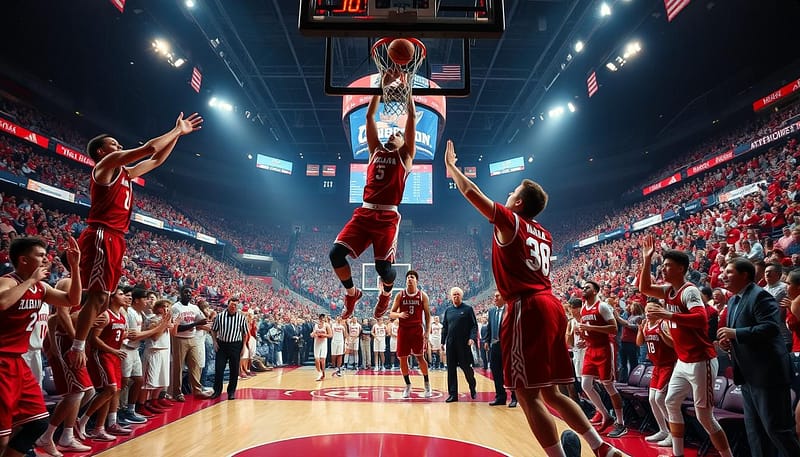
Alabama’s 1-9 Sweet 16 record is a big issue for the team. With six SEC regular season titles, their March Madness struggles are hard to understand. Why can’t they succeed in basketball like they do in football?
Gonzaga’s journey from underdogs to top contenders is inspiring. They’ve built a strong team through smart recruiting and consistent play. Alabama, on the other hand, seems to promise a lot but often falls short.
The 2004 Elite Eight run was a highlight and a lesson for Alabama. Mark Gottfried’s team showed they could play with the best but couldn’t win it all. This experience has left a lasting impact on the program.
Today, Alabama basketball is caught in a dilemma. They rely heavily on three-pointers, which can be both a blessing and a curse. When they make those shots, they’re unstoppable. But when they don’t, their offense falters quickly.
- Sweet 16 record: 1-9 in the last 40 years
- Three-point reliance: 40%+ attempts in last 5 tournaments
- Turnover margin: Negative in 7 of 9 elimination games
Is the key to success more focus on the paint? Better defense? Or just waiting for luck to change? Until then, Crimson Tide fans will keep hoping for a better March.
Traditions and Fandom
Alabama basketball traditions are like a mix of a live concert, a southern cookout, and Shakespearean drama. It’s not just fandom; it’s performance art with a lot of noise. Visiting Coleman Coliseum is like going to church, but with face paint and zone defense cheers.
The Bryant Museum is more than a trophy case. It’s a time capsule where Bear Bryant’s houndstooth hat is as revered as basketball artifacts. Exhibits include Wimp Sanderson’s plaid sport coats and game-worn jerseys from the 2004 Elite Eight. The “Floor Stories” display lets you literally walk through key moments in Tide hoops history.
The “Rammer Jammer” cheer is the real MVP. It started as a football victory chant but now has hoops-specific lyrics. Student sections have made it a living meme, adding new verses during big wins.
Tradition Showdown: Coleman vs. Cameron
| Element | Coleman Coliseum | Cameron Indoor |
|---|---|---|
| Signature Atmosphere | Bass-heavy hype videos | Acapella fight songs |
| Crowd Traditions | Elephant Walk procession | Silent free throw nights |
| Decibel Levels | Peak: 112 dB (jet engine territory) | Peak: 96 dB (loud restaurant) |
The Elephant Walk in hoops is like a Mardi Gras parade before games. Superfans like Mark Ingram are an unofficial recruiting tool. Prospects get starstruck by his “Roll Tide!” high-fives more than NBA scouts.
These traditions aren’t static; they change fast. The student section’s phone flashlights during player intros went viral quickly. It shows Bama’s fandom is as flexible as Nate Oats’ offense.
Program’s Current Standing
Nate Oats’ Alabama basketball program is like a tech startup in a bourbon-scented SEC boardroom. His analytics revolution has made the Tide a hub for modern basketball. They use three-point shots and positionless lineups.
Assistant coaches are getting poached like hot biscuits at a church potluck. Well…
The recent staff exodus tells a story. When three assistants leave in two years, it’s a sign of success. Bryan Hodgson going to Arkansas State is a big deal.
These departures say: “We’ve cracked the code on developing NBA talent, and everyone wants our playbook.” It’s a compliment in college sports.
Now, the real test is if Bama’s NIL collective can attract top recruits. The Yea Alabama collective offers deals and charity partnerships. But does being transparent help or hurt in getting blue-chippers?
Three things suggest Alabama will keep succeeding:
- Oats’ system produces NBA-ready wings like a factory line
- SEC Network money keeps facilities cutting-edge
- NIL opportunities leverage Alabama’s national brand better than most
The question isn’t if Alabama basketball will have breakout seasons – they’ve already had them. It’s if they can win their first Final Four banner. Or will they stay the most fascinating almost contender?
Conclusion: Honoring the Past, Building the Future
Alabama basketball is more than just old memories. It’s about teams like Leon Douglas’s 1976 SEC title team. They paved the way for today’s players, like Brandon Miller, who made it to the 2023 NBA draft.
The Crimson Tide’s greatest wins aren’t just about championships. It’s about staying relevant and not getting stuck in the past. C.M. Newton once said tradition isn’t just for display. Nate Oats’s modern offense in 2023 showed that.
Mark Sanderson said being good in March is key. Alabama’s journey forward is like their 1973 NIT championship team. They’re ready to adapt and succeed, just like Wimp Sanderson’s 1987 SEC tourney run.
The goal is to honor history while moving forward. Alabama’s story is far from over. It’s just beginning.