Seventy-four years is a long time to wait for anything. For a football program dripping with southern tradition, it felt like forever.
The University of Alabama built legends while the Heisman Trophy went elsewhere. From the Great Depression to the Great Recession, that stiff-arming statue avoided Tuscaloosa like a bad blind date.
Then the dam broke. Mark Ingram in 2009. Derrick Henry in 2015. DeVonta Smith in 2020.
Three winners in just over a decade. What changed? Was it the players, the system, or simply football karma catching up?
We’re not just listing names here. This is an autopsy of a narrative flipped on its head. The compact powerhouse who broke the seal. The gargantuan tailback from another football era. The “too-small” receiver putting up video game numbers in a pandemic year.
Each profile tells a different story about what this award means. For deeper quarterback stories, check out profiles like Chris Weinke’s journey as an older.
To understand the full context of Alabama football legends, Crimson Traditions provides essential archival depth. Because sometimes, the honor isn’t just about the player. It’s about when they arrive.
Career Highlights
What does it take to win the Heisman Trophy away from the usual suspects? For Alabama, it was all about sheer production. These weren’t just good seasons; they were chaotic, forcing voters to notice Tuscaloosa.
Mark Ingram in 2009 set the stage. His 1,648 rushing yards and school record are impressive. But it was his performance in the SEC Championship against Florida that stood out. Ingram’s fourth-quarter runs were not just gains; they were statements. That season made him an award winner and helped Alabama win the national championship.

Derrick Henry in 2015 took the “workhorse” concept to new heights. He broke Herschel Walker’s SEC record with 2,219 yards. Henry’s 395 carries were a weekly physics lesson, dragging defenders for extra yards. His Heisman campaign was a testament to old-school endurance, ending with a national title.
DeVonta Smith’s 2020 Heisman season was a different kind of masterpiece. After Jaylen Waddle’s injury, Smith became the “Slim Reaper.” His 105 catches for 1,641 yards and 22 touchdowns were precise. The one-handed snag against LSU is unforgettable. Smith’s season showed a receiver could be the most outstanding player.
So, what’s the common thread for these Alabama award winners? It was never about flash for its own sake. It was about production that became indispensable. Ingram provided clutch power, Henry offered unstoppable volume, and Smith delivered game-breaking precision. Each season told a unique story, but all shared the same ending: they defined an era of Crimson Tide football.
Lasting Legacy
What does a 45-pound bronze statue really buy in terms of legacy? For DeVonta Smith, it was the Empire State Building lit up in red. That’s right—a New York City skyscraper became his victory lamp. In today’s world, when parades seem old-fashioned, lighting up a famous building is the ultimate “I told you so.”
His emotional speech, filled with the weight of doubt, didn’t just thank coaches and family. It became a classic sports acceptance speech. Smith wasn’t just the first wide receiver to win in 29 years; he was a narrative correction. He showed that finesse can beat size in the modern game.
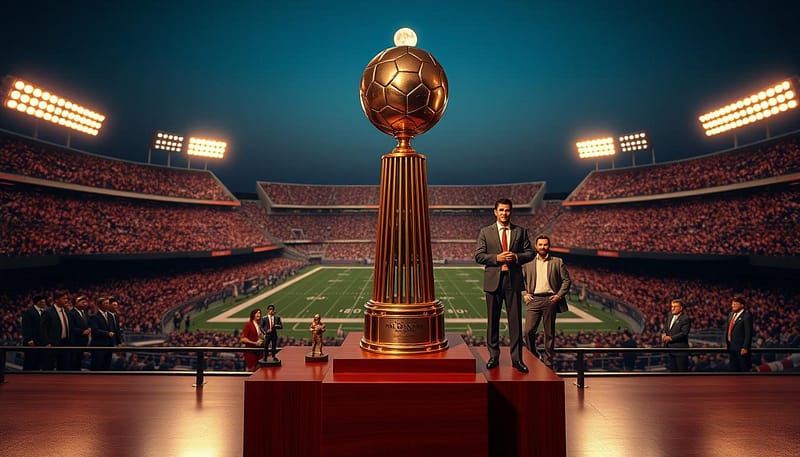
But the legacy goes beyond individual moments. Mark Ingram and Derrick Henry didn’t just win the Heisman; they also got national championship rings. Their Heisman wins are tied to Alabama’s dynasty. The trophy was a personal win, but the ring was the team’s victory.
This is where individual brilliance meets football history. The Heisman Trophy is a unique artifact. It’s modeled after Ed Smith, a 1930s NYU player. It has been given to future leaders, broadcasters, and icons. Its value is so high that past trophies sell for hundreds of thousands of dollars, becoming pieces of Americana.
Alabama’s trio has a special place in football history. They are part of the gritty lore of Crimson Tide football. They are also part of the broader, romantic story of American college football. They didn’t just win an award; they became characters in the sport’s epic.
The Heisman’s true power isn’t just about stats. It’s about changing perceptions. It turns a college athlete into a reference point. Analysts will remember, “He’s the first receiver to win like DeVonta Smith.” Historians will note Henry’s 2015 season was a throwback to the past. This is the award’s magic: it freezes a season, a player, a moment, and adds it to the sport’s memory.
So, the legacy for these Alabama winners is complex. It’s about personal triumph (overcoming size, leading a team). It’s about program validation (tying individual glory to team success). And it’s about historical integration. They are now part of the game’s history. Their stories are no longer just their own; they belong to football history.
Role in Program Prestige
Prestige in college football is like money. Alabama had all the coins, but not the Heisman Trophy. That changed when Mark Ingram won in 2009. It was a big deal, opening the door to the sport’s elite.
These Heisman Heroes showed Saban’s success wasn’t just luck. They fueled his winning machine. Each winner helped Alabama become a national champion. This success turned the Heisman Trophy into a symbol of excellence.
It became a magnet for top talent. The Heisman’s history proves it’s the ultimate achievement in college football.
USC, Ohio State, Oklahoma, and Notre Dame have their own Heisman collections. Alabama, once new money, joined their ranks. The 2020 season showed Alabama’s strength. Three players made the top five, a feat not seen in 75 years.
The Heisman Heroes of the Saban era did more than win games. They boosted Alabama’s reputation. They helped build a dynasty, turning individual talent into a key part of the Alabama brand. In football, legends create programs. Alabama now creates legends with trophies to prove it.