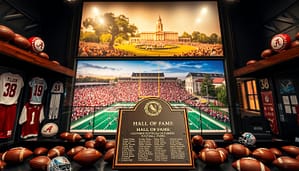
In college football, the offense gets all the glory. But Alabama’s true strength lies in its defense. The Crimson Tide has won an impressive 14 national titles.
From 1926 to 2011, Alabama’s defense has been unmatched. It’s not just a list of names. It’s about understanding why some roles are forever remembered at Alabama.
The defensive line, known as the “Rolling Thunder,” was unstoppable. Players like Terrence Cody, who weighed 400 pounds, controlled the field. The linebackers, like Lee Roy Jordan, were the team’s brain. And the secondary, with players like Antonio Langham, was all about intercepting the ball.
This approach built Alabama’s empire on saying “no.” It’s the same level of talent found on an all-time NFL team by position. At Alabama, defensive dominance is the foundation of their dynasty.
Signature Games and Plays
Statistics are for accountants; legacy is written in the blinding flash of a single, perfect play. Anyone can compile numbers. But immortality? That’s forged in the pressure cooker of a championship fourth quarter, where one action etches a name into cultural memory forever.
Consider the 2009 Tennessee game. Alabama clung to a two-point lead. Tennessee lined up for a game-winning 44-yard field goal. Enter Terrence Cody, a human mountain range wearing cleats. He didn’t just block the kick—he swatted it away like a bothersome insect, preserving an undefeated season. The myth of the 2009 national championship doesn’t exist without that seismic swat.
Then there’s the 1993 Sugar Bowl. The “unbeatable” Miami Hurricanes were executing their swaggering, high-stepping offense. George Teague watched Lamar Thomas intercept a pass and begin his celebratory return. What happened next is pure cinematic defiance. Teague chased him down from behind and executed “The Strip.” He didn’t just take the ball back; he deconstructed Miami’s entire aura of invincibility with one act of sheer will.
The 1979 Sugar Bowl offers perhaps the purest defensive poetry in Alabama lore. Penn State, first and goal at the one-yard line. Four plays. Four brutal stops. At the heart of it was Barry Krauss, the linebacker who met fullback Mike Guman head-on on fourth down. It wasn’t a tackle; it was a statement. A defensive Gettysburg Address—short, violent, and eternally defining.

Fast forward to 1992. The SEC Championship hung in the Georgia Dome air. Florida driving. Antonio Langham read the quarterback’s eyes, stepped in front of the pass, and sealed Alabama’s ticket to the Sugar Bowl. That interception wasn’t just a turnover; it was the period at the end of a championship sentence.
Rewind further to the 1963 Sugar Bowl. Oklahoma’s offense met a crimson wall named Lee Roy Jordan. The middle linebacker made 31 tackles in a 17-0 shutout. Thirty-one. In one game. That’s not a stat line; it’s a one-man demolition derby. He didn’t just play defense; he authored a masterclass in defensive obsession.
Even in the 1942 Cotton Bowl, the pattern held. Holt Rast, playing both ways, snatched a Texas pass and returned it for a touchdown. A pick-six in the grandest setting. These moments answer the question: what does clutch look like?
It looks like a 350-pound nose guard rejecting a kick. It looks like a safety refusing to let an interception stand. It looks like a linebacker becoming an immovable object at the one-yard line. These aren’t plays. They’re plot twists in Alabama’s epic football narrative.
Each one transformed athletes into legends. They moved beyond the realm of sport and into the territory of cultural artifact. We remember them because they represent the ultimate convergence of skill, opportunity, and nerve. The moment when a player stops competing and starts defining.
That’s the alchemy of signature plays. They distill an entire career, an entire season’s struggle, into one crystalline moment of perfection. They’re why we watch. We’re waiting for the next moment when history is written not in ink, but in turf and triumph.
Impact Beyond the Field
What makes a defensive legacy stand out? It’s not just about tackles or interceptions. It’s about the knowledge and skills a player brings to the game. Antonio Langham, for example, didn’t just play defense. He showed the world how to anticipate and excel, earning the highest honor for a defensive back in college football.
These achievements shape a team’s identity. Derrick Thomas’s record of 27 sacks in a season is more than a number. It’s a fear that haunts coaches to this day. Cornelius Bennett’s three All-American awards show his consistent greatness. He’s in the College Football Hall of Fame, alongside legends like Lee Roy Jordan and Woodrow Lowe.
The legacy of a player can grow into a loud voice. The significance of any Hall of Fame is in how it changes the game. It makes achievements last forever. It shows that the smartest and toughest players shape an era, even after they’re gone.
The biggest impact is on culture. Think of the 2008 team that brought back a dynasty. These achievements set high standards. They motivate players like Rolando McClain or DeMeco Ryans. The skills and knowledge of the secondary and linebackers are what build lasting programs.