In college football, success often has a family tree. A coaching tree maps the professional lineage of mentors and their protégés. It’s more than a list of names. It traces the spread of philosophy, culture, and winning ways across the sport.
Few programs have a root system as deep and prolific as Alabama’s. Legendary figures like Paul “Bear” Bryant and Nick Saban didn’t just win championships. They built a legacy through the coaches who learned under them. Their assistants spread across the country, taking lessons in leadership and strategy.
This mentorship web created a lasting impact on how the game is played and taught. Tracking these connections reveals how tactical innovations and cultural standards evolve. So, how did these Alabama roots grow to shape the entire landscape of modern college football?
Influential Proteges
Bear Bryant and Nick Saban have shaped many football leaders in Tuscaloosa. Their success is seen in the achievements of their students. These coaches used Alabama’s lessons to build winning teams elsewhere.
Gene Stallings is a notable example. He played for Bryant and later coached with him. Stallings won a national title in 1992, showing Bryant’s influence.
Sylvester Croom was the first African American SEC head coach at Mississippi State. A former Alabama player and Bryant’s assistant, Croom emphasized discipline and running games. His career shows how Alabama’s football roots can lead to success and breaking barriers.
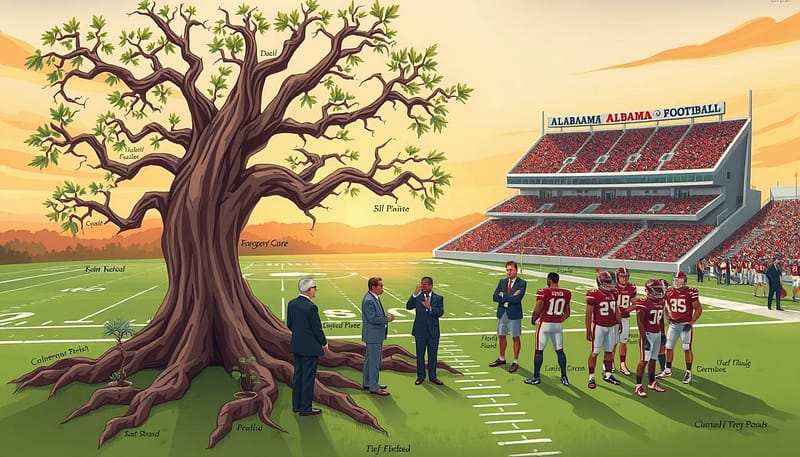
Nick Saban has created a vast coaching tree. His assistants now lead top programs, all following “The Process.” Their shared roots are clear.
Kirby Smart (Georgia) is Saban’s most successful protege. He was Saban’s defensive coordinator before building a dynasty at Georgia. His team’s focus on defense and running is Saban’s legacy.
Jimbo Fisher won a national title at Florida State and led Texas A&M. His offense evolved, but his focus on toughness and roster management comes from Saban at LSU.
Steve Sarkisian (Texas) and Lane Kiffin (Ole Miss) are the offensive branches. Both are known for their innovative play-calling. They learned from Saban how to build a program, not just an offense.
| Coach (Protege) | Current Program | Notable Achievement | Saban’s Visible Influence |
|---|---|---|---|
| Kirby Smart | Georgia Bulldogs | Multiple National Championships (2021, 2022) | Elite defense, “Process” culture, intense recruiting focus |
| Jimbo Fisher | Formerly Texas A&M Aggies | National Championship (2013 at Florida State) | Program-building philosophy, emphasis on the “competitive edge” |
| Steve Sarkisian | Texas Longhorns | Big 12 Championship, College Football Playoff appearance (2023) | Structured practice organization, balanced offensive attack |
| Lane Kiffin | Ole Miss Rebels | Multiple SEC division contender, high-powered offenses | Adaptive game planning, leveraging talent mismatches |
The impact of Alabama’s coaches is undeniable. From Bryant to Saban, they provided a winning blueprint. Their students took these systems to new heights, creating a network of success. This network stems from Alabama’s football roots.
Impact on NCAA and NFL
Alabama’s coaching trees have a big impact beyond campus. Nick Saban’s defensive strategies and organizational skills are now the norm. College teams across the NCAA study and use these methods to build winning cultures.
This influence also reaches the NFL. Saban and his predecessors have mentored a generation of football minds. Their students now lead NFL teams, shape game plans, and make key decisions. They have shaped professional play styles and front-office strategies.
The lasting legacy of Alabama’s Hall of Fame coaches is not just their own success. It’s in the continued success of their proteges. This network has changed how coaches are developed. It has also changed the competitive dynamics in college and professional football.