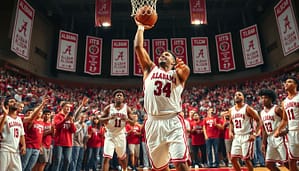
Bear Bryant once joked that coaching legends outlast cleats in Tuscaloosa. He wasn’t wrong. This program churns out gridiron demigods who make Saturdays unforgettable. From the 1892 teams to Nick Saban’s “football AI”, the Crimson Tide has 14 national titles.
Mark Ingram’s 2009 Heisman moment was a game-changer. His 69-yard dash against Florida was more than a touchdown. It was a cultural reset. Bryant’s ghost must have been laughing from above.
Today’s recruits are not just joining a team. They’re auditioning for a role in college football’s epic story. It’s like Hamilton with dynastic drama and trophy-room soliloquies.
Saban’s method is ”industrial-grade legacy manufacturing.” His 44 first-round NFL picks have rewritten the NCAA record book. Yet, for every Heisman statue, there are three All-Americans who paved the way.
So why does this matter? Alabama’s All-Americans show us that true greatness is lasting. It’s etched in championship plaques and whispered in locker rooms. Sometimes, it’s even frozen in a Heisman pose.
What’s an All-American?
Imagine the Electoral College giving out Michelin stars. That’s what the All-American selection process is like. It’s a mix of politics, prestige, and top-notch athletic skills. These honors are not just for showing up; they prove a player’s true greatness.
To become a consensus All-American, players face a tough test. They must win over the AP, coaches, and Walter Camp. It’s like getting a five-star review from food critics.
But it’s not about being popular. It’s about raw stats and dominance. Derrick Thomas in 1988 is a perfect example. He had 28 sacks and 45 tackles for loss. His play changed the game.
Bear Bryant once said, “I don’t recruit All-Americans, I make them.” He was right. Alabama has a long history of turning talent into consensus All-Americans. It all started with Wallace Wade in the 1920s. His simple yet effective approach turned Tuscaloosa into a talent factory.
Today, the selection process is similar. Voters look for:
- Big stats (like 300-yard games)
- Key wins against top teams
- A special “it factor” that makes a player stand out
That’s why Alabama players are often at the top of these lists. They’re not just athletes; they’re the blueprint for football excellence. From Joe Namath’s confidence to Minkah Fitzpatrick’s defensive skills, they set the standard.
Early All-American Pioneers
Before Saban’s spreadsheets and GPS, Alabama’s first All-Americans made their mark. They used leather helmets and had the strength of farmhands. These weren’t just athletes; they were gridiron revolutionaries who transformed cotton country into a football hub.
The 1925 Rose Bowl team did more than just win a game. They declared Southern football independence. When Wallace Wade’s team went to Pasadena, critics doubted them. But they came back with a 20-19 win, changing college football’s map.
Millard “Dixie” Howell and Poison Ivy Williamson were the stars of the 1930s. This dual-threat QB/Safety was like the Bo Jackson prototype. He played with a toughness that was unmatched, even back then.
The 1941 Ironmen took toughness to new heights. While America was gearing up for war, Frank Thomas’ team played 11 ironman games. They played every minute of every game, showing the spirit of the Greatest Generation.
Now, let’s compare this to modern Bama football:
- 1930s pre-game prep: Chewing tobacco and checking bootlaces
- 2020s pre-game prep: Cryotherapy sessions and cognitive load assessments
Both eras wear the same crimson jerseys. But they show different sides of Bama’s spirit. Both believe in the power of shared purpose and determination.
Bryant Era All-Americans
Bear Bryant’s coaching was like a vinyl record, all about defense. His six championship seasons brought more first-team All-Americans than you can count. He created a new kind of player: the southern-fried defensive expert.
The 1979 Sugar Bowl was a big deal for defense fans. Penn State was facing a 4th-and-goal at the 1-yard line. Barry Krauss made a goal-line stand that changed the game. It was like Alabama’s linebacker was rewriting history.
Bryant’s team was like a Marvel crossover event:
- Lee Roy Jordan: 31 tackles in the 1963 Orange Bowl – a defensive feat
- Johnny Musso: Made defenses look silly in 1971
- Woodrow Lowe: Five-time All-SEC before hydration breaks were common
Joe Namath was like Mick Jagger in cleats. His 1964 first-team All-America nod was about more than stats. It was about his swagger, so strong it could’ve been bottled.
Ken “The Snake” Stabler got his nickname for good reason. He was like a snake in the 1967 monsoon game. Bryant turned his bayou skills into a 27-4 record as starter. It was a real talent.
Bryant didn’t just recruit players. He collected unique personalities. This led to a golden era where Alabama’s defenders were almost guaranteed to be All-Americans.
Saban Era: All-American Machine
Nick Saban didn’t just start a football program in Tuscaloosa. He created a top-notch machine that turns talent into NCAA football awards winners. From 2007 to now, the Crimson Tide has produced 46 All-Americans. This is like a Swiss watch, always consistent.
The DB Whisperer’s Masterpiece: Minkah Fitzpatrick was a four-star recruit. Saban turned him into a 2017 Thorpe Award winner. It’s like watching a chess grandmaster work.
Julio Jones: The David of Combine Metrics: His 2011 NFL Scouting Combine was amazing. It was like Michelangelo’s David in numbers.
- 40-yard dash (4.39s) = Michelangelo’s David height-to-width ratio
- Vertical jump (38.5″) = Golden Section spiral in Botticelli’s Birth of Venus
- Broad jump (11’3″) = Fibonacci sequence in Brunelleschi’s dome
Tua’s 2018 Symphony: Tua’s national championship game against Georgia was incredible. It was like big data meets jazz.
- 3 touchdowns in 26 minutes
- 0 turnovers despite 5 sacks
- The iconic “2nd and 26” dime to Devonta Smith
Saban’s teams have made 14 NFL Draft picks. It’s not just recruiting. It’s talent alchemy. Saban mixes combine metrics with his own magic to create stars.
Most Decorated Crimson Tide Players
Imagine a video game character maxed out on every stat – that’s Alabama’s triple crown winners. These legends didn’t just play college football; they broke reality. They earned All-American honors, championship rings, and first-round draft status. Let’s dissect the glitches in the matrix.
Derrick Thomas rewrote defensive playbooks like a hacker infiltrating the system. His 27 sacks in 1988 remain an unshakable school record. It’s the kind of stat that makes modern pass rushers mutter “impossible difficulty setting.” The Butkus Award winner anchored a defense so dominant, it should’ve come with a parental advisory label.
Then there’s Shaun Alexander’s 1999 season – the human cheat code. His 19 rushing touchdowns looked like someone held down the “juke stick” button permanently. Defenses wake up in cold sweat remembering his spin moves, which violated at least three laws of physics.
The Wide Receiver Enlightenment arrived in 2020 with DeVonta Smith. The Heisman Trophy committee basically surrendered when his 1,856 receiving yards vaporized entire secondaries. His trophy case now needs structural reinforcement – All-American status, national title, and a top-10 draft pick all before his morning coffee.
Alabama’s Heisman Hall of Fame reads like a VIP list:
- Mark Ingram (2009) – first Bama player to grab the stiff-arm trophy
- Derrick Henry (2015) – human bulldozer with a 2,219-yard receipt
- DeVonta Smith (2020) – 215-pound proof that size doesn’t matter
These players didn’t just collect Alabama football honors – they set the blueprint for how to dominate college football’s most unforgiving difficulty level. Their legacies aren’t written in record books. They’re carved into the sport’s DNA.
Position-by-Position Greats
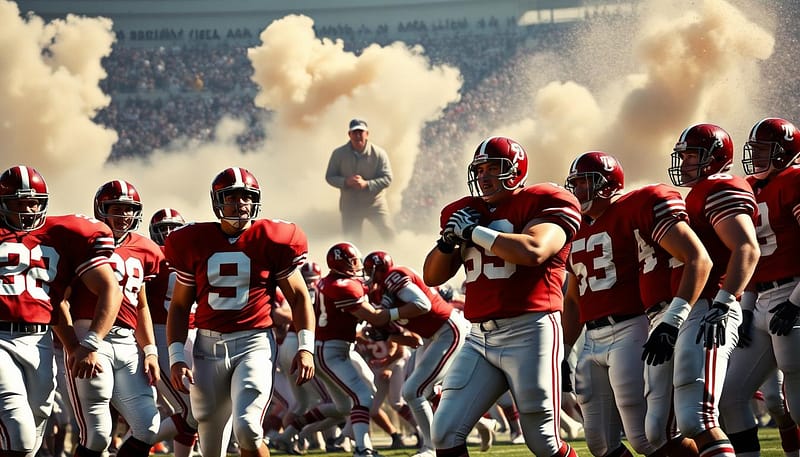
Choosing Alabama’s all-time position leaders is like picking the best art for the Louvre. Each piece is a masterpiece, but there’s only so much room. Let’s start debates as hot as a summer scrimmage with these first-team All-America showdowns.
Tailback Thunder: The 2,000-Yard Conundrum
Derrick Henry’s 2015 Heisman campaign was like a natural disaster. But does his 2,219 yards beat Shaun Alexander’s 3,565 career yards and 40 TDs? Henry’s stats look like a video game, but Alexander faced tougher SEC defenses.
Mark Ingram’s 2009 Heisman win was a turning point for Alabama. It was when Saban’s team became unstoppable.
Wide Receiver Renaissance: Picasso vs. Da Vinci
Jerry Jeudy’s 2018 Biletnikoff Award season was like a work of art. His performance against Georgia is unforgettable. But Julio Jones’ 2008 season, with 58 catches, might be even more impressive.
It’s like comparing Michelangelo’s David to Banksy’s shredded painting. Which one is more impactful?
Trench Warfare: Cornbread vs. Algorithms
John “Cornbread” Clemons played in the 1970s like his jersey was on fire. But how would his blocks compare to Landon Dickerson’s 2020 Outland Trophy stats? Dickerson’s 92.3% run-block efficiency is impressive.
Nostalgia says Cornbread’s old-school style was the real deal. It’s a flip phone vs. smartphone debate.
This isn’t just about numbers. It’s about understanding football’s history. Each era’s stars show how the game has changed. Today’s stats monsters and yesterday’s ironmen both played a part. The real winner? Anyone who loves debating these matchups over drinks.
Record-Breaking Seasons
If Alabama football seasons were Netflix series, 2011 and 2012 would be the binge-worthy thrillers you’d watch twice. These campaigns didn’t just win trophies—they rewrote playbooks, broke algorithms, and left statisticians muttering “Roll Tide” under their breath. Let’s dissect two eras where Bama’s dominance went from impressive to mathematically unfair.
The Defensive Chess Match That Broke Football
The 2011 “Game of the Century” against LSU wasn’t a football game—it was a 9-6 defensive séance where both teams collectively decided offense was overrated. Saban and Les Miles turned the sport into a 3D chess match, with Alabama’s defense allowing just 8.2 points per game that season. But the real magic came in 2012, when that same unit evolved into college football’s Death Star:
| Stat | 2011 | 2012 |
|---|---|---|
| Points/Game Allowed | 8.2 | 10.9 |
| Total Yards/Game | 191.3 | 250.0 |
| Turnovers Forced | 20 | 32 |
| NCAA Rank | #1 | #1 |
Notice the “worse” 2012 stats? That’s the defensive equivalent of a caffeine crash after playing 13 NFL-caliber teams in 14 weeks. This unit featured future All-Americans like C.J. Mosley and Dee Milliner, captained by center Barrett Jones—a man who played three positions while apparently majoring in gridiron terrorism.
Special Teams: The Dark Web of Football Analytics
While everyone fixated on T.J. Yeldon’s heroics, Landon Collins was racking up 22 special teams tackles in 2014—the football equivalent of scoring perfect SATs while working a part-time job. These hidden efforts boosted Alabama’s field position like Wall Street quants manipulating stock prices, proving that NCAA football awards should come with a “Most Likely to Do Invisible Work” category.
Rushing Titles: Then vs Now
Johnny Musso’s 1971 season (1,487 yards, 16 TDs) was like watching Picasso paint with a chainsaw—brutal yet artistic. Compare that to Derrick Henry’s 2015 Heisman campaign (2,219 yards, 28 TDs):
| Category | Musso (1971) | Henry (2015) |
|---|---|---|
| Carries/Game | 21.4 | 26.6 |
| Yards After Contact | N/A* | 1,078 |
| Team Captains | Musso | Ryan Kelly |
| Defenses Faced | 7 Top-20 | 9 Top-25 |
*Because 1971 statisticians were too busy smoking cigarettes to track such details
Musso’s captaincy-era grind versus Henry’s volume stats reveals how NCAA football awards have become spreadsheet Olympics. Yet both backs shared one trait: they turned fourth quarters into victory formation auditions.
National Recognition: Bama’s Place in History
Alabama football is more than a team; it’s a powerhouse in college football. It produces All-Americans like tech giants make billionaires. While others focus on tradition, Alabama’s trophy case is a historical archive of success. But how does it stack up against other blue bloods? Let’s look at the numbers like Wall Street analysts.
Notre Dame’s “subway alumni” era (1920s-1940s) made them America’s team. They won eight national titles and had 50 consensus All-Americans. That’s 6.25 per title. Now, let’s see Alabama’s modern success:
| Program | Era | Titles | Consensus All-Americans | Per Title Ratio |
|---|---|---|---|---|
| Notre Dame | 1924-1949 | 8 | 50 | 6.25 |
| Alabama | 2009-2023 | 6 | 43 | 7.16 |
Alabama’s 15% higher ratio is more than numbers—it’s cultural infrastructure. In 2020, COVID hit, and empty stadiums were new challenges. Yet, Alabama won six titles and had a perfect record. Paul Finebaum said it best: “They’re not cheating—they’re just better.”
This isn’t just about recruiting. It’s a blueprint. Alabama’s walk-ons train like Avengers, and their nutrition is Olympic-level. Other schools develop players; Alabama engineers them.
Pathways to the NFL
Nick Saban once called Alabama “the NFL’s favorite minor league.” This was a compliment that didn’t quite do justice to the Tide’s player development. From 2000 to now, 53 first-round picks have come from Alabama. This has made NFL front offices feel like Bama alumni reunions.

The journey from Bart Starr’s 1956 scouting report to Mac Jones’ 2021 pro day shows more than just tech progress. It highlights how Crimson Tide players became the league’s top picks:
| Era | Scouting Method | Alabama Standout | Draft Impact |
|---|---|---|---|
| 1950s-60s | Handwritten notes | Bart Starr | 17th round steal |
| 2000s | Combine metrics | Julio Jones | Falcons traded 5 picks to move up |
| 2020s | Virtual reality assessments | Mac Jones | Patriots’ post-Brady gamble |
Recent draftees like Patrick Surtain II are changing the game. His 2021 combine performance was about more than speed. It was about how many GMs suddenly sounded like they were from the South when talking about his “football IQ.”
The real magic is in the details. While others focus on combine stats, NFL teams value Alabama’s players for their pro-style playbooks and Saban’s film study habits. It’s no surprise that 11 different teams have drafted multiple Tide players in the last five years. They’re buying both talent and the knowledge that comes with it.
As virtual reality replaces traditional interviews, one thing remains the same. Whether scouts use stopwatches or VR headsets, they always come to the same conclusion. In the high-stakes world of the draft, Crimson Tide players are the ones who usually come out on top.
How All-Americans Shape Team Culture
Every Alabama championship ring has an All-American’s mark on it. These players don’t just win games; they shape the team’s spirit. They mix toughness, charm, and a bit of southern spirit into a unique team philosophy. This is seen in the team’s dynamic.
DeMeco Ryans was like a librarian with a secret stash of grenades. Tua Tagovailoa brought a Hawaiian vibe to practice, making it feel like a party. Their different approaches led to the same goal: winning championships. Gene Stallings once said, “Leadership isn’t about volume—it’s about making the guy next to you louder.”
The 2015 loss to Ole Miss was a turning point for Alabama. Down 43-37, leaders like Reggie Ragland focused on teamwork, not just winning. They realized they needed more unity, not just individual talent. This led to a 12-game winning streak.
Andre Smith’s 2008 season was about more than just blocking. His efforts laid the groundwork for future success. Every All-American added to this foundation, from Julio Jones’ work ethic to Bryce Young’s clutch performances. They built a team that keeps getting stronger.
Today’s recruits join a leadership laboratory shaped by All-Americans. This culture endures through coaching changes and rule updates. In Tuscaloosa, legends inspire future generations, setting high standards.
Conclusion: The Legacy of Excellence
Alabama All-Americans are more than just athletes. They are cultural icons. Players like Don Hutson and Derrick Thomas have left an indelible mark. Nick Saban’s 2024 team, with five preseason All-Americans, shows the program’s power.
But what happens when Saban steps down? Tuscaloosa’s magic is in its mix of Southern football and Saban’s precision. Julio Jones and Bryce Young have pushed the limits of what’s possible. This has led to 86 All-Americans becoming first-round draft picks.
Can anyone else match Alabama’s success? Oregon and Georgia try, but they can’t replicate Bama’s magic. Bear Bryant’s legacy lives on through players like Will Anderson Jr. and Jalen Milroe. Legacy is in the DNA, not just trophies.
As the SEC grows and NIL changes recruiting, a big question remains. Will future Alabama All-Americans uphold or rewrite the standard? Saban’s secrets are locked away, but the answer is clear. Watch the game.